
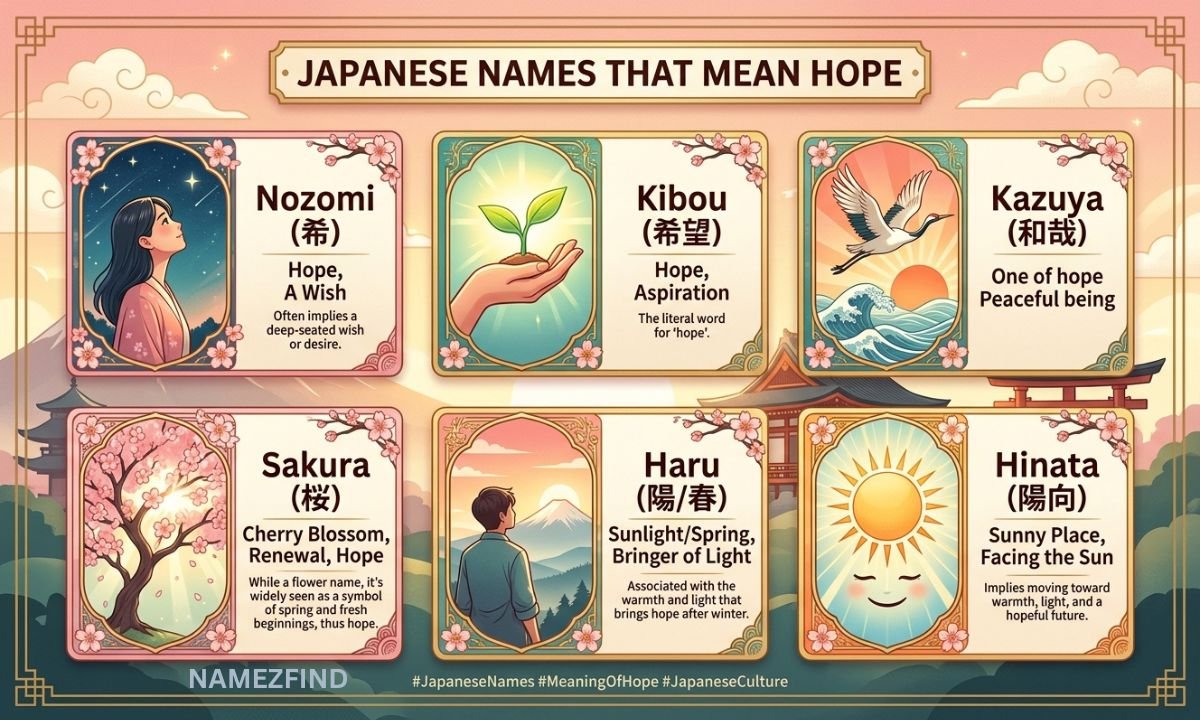
Choosing a name is a big moment for any parent. It sets the tone for a child’s whole life. Japanese names often carry deep meaning, and hope is one of the most loved themes. These names feel warm, positive, and full of promise.
Hope-themed names come from special kanji characters. Each kanji has its own meaning and sound. Some names use symbols for light, dreams, or new beginnings. Others simply mean “wish” or “hope” in a direct way. This makes each name feel personal and unique.
In this list, you will find names for boys and girls. We share their meanings, kanji, and how to say them. Whether you want a soft sound or a strong one, there is something here for you. Let’s explore these hopeful Japanese names together.
Why Japanese Names That Mean Hope Are Special
Japanese names that mean hope stand out because Japanese itself allows a single idea like “hope” to be written and read in dozens of different ways through kanji. A name built on 希 (nozomi), 望 (nozomu), or 希望 (kibou) doesn’t just sound pleasant — it carries a lifelong message that the child is meant for brighter days. Parents often choose these names after a difficult pregnancy, during a hopeful new chapter, or simply because they want their child to grow up associating their own name with optimism. Unlike many Western “hope” names, Japanese hope names can be layered with a second meaning — light, dawn, a star, a dream — so the name tells a small story rather than stating a single word. That layered symbolism is exactly why these names travel so well outside Japan, appearing in nurseries, novels, and character names around the world.
🌅 Best Japanese Names That Mean Hope
Generate beautiful Japanese names inspired by hope, dreams, wishes, light, optimism, and new beginnings.
Japanese Names That Mean Hope
This core list gathers well-rounded Japanese names that mean hope, suitable for any child regardless of style preference. Each one leans on a kanji rooted in hope, light, wishing, or dreaming.
- Miraitoya (未来翔) — carries the gentle promise of one who flies to the future, a favorite for parents who want optimism woven into a name.
- Shinoha (篠望) — leans on gentle hope, a warm pick for families who want hope present in everyday life.
- Harutoma (陽翔) — captures soaring toward hope, ideal for parents wanting a name with quiet strength.
- Kanatako (彼方) — means hope beyond the horizon, a soft yet powerful wish parents pass down through the name.
- Tsubasasuke (翼) — represents wings of hope, chosen for its uplifting, forward-looking tone.
- Negaidai (願) — represents wish, chosen for its uplifting, forward-looking tone.
- Sachikoka (幸子) — carries the gentle promise of child of hope and happiness, a favorite for parents who want optimism woven into a name.
- Nozokana (希花) — means flower of hope, a soft yet powerful wish parents pass down through the name.
- Haruki (陽希) — conveys sunlit hope, a name that ages gracefully from childhood into adulthood.
- Kokoroma (心) — signals heart, seat of hope, and pairs beautifully with traditional Japanese surnames.
- Koukiji (希輝) — conveys shining hope, a name that ages gracefully from childhood into adulthood.
- Negaimi (願) — is built around wish, offering a daily reminder to keep looking forward.
- Natsukimi (夏希) — is built around summer hope, offering a daily reminder to keep looking forward.
- Minoruta (実) — means hope that bears fruit, a soft yet powerful wish parents pass down through the name.
- Ryoukito (凌希) — captures hope that endures, ideal for parents wanting a name with quiet strength.
- Yumemi (夢) — draws from dream, symbolizing brighter days ahead even in uncertain times.
- Miraiko (未来) — means future, a soft yet powerful wish parents pass down through the name.
- Izumine (泉) — captures wellspring of hope, ideal for parents wanting a name with quiet strength.
- Tsubasayo (翼) — centers on wings of hope, making it an encouraging choice for a newborn.
- Hikaruki (光) — represents radiant hope, chosen for its uplifting, forward-looking tone.
- Izumimi (泉) — carries the gentle promise of wellspring of hope, a favorite for parents who want optimism woven into a name.
- Hikarika (光) — reflects light of hope, often chosen for children born during hopeful new beginnings.
- Tomokana (灯花) — is built around flower-lit hope, offering a daily reminder to keep looking forward.
- Akikoka (明子) — captures bright child of hope, ideal for parents wanting a name with quiet strength.
- Nozomine (希) — signals hope, and pairs beautifully with traditional Japanese surnames.
- Minoru (実) — signals hope that bears fruit, and pairs beautifully with traditional Japanese surnames.
- Negaisuke (願) — conveys wish, a name that ages gracefully from childhood into adulthood.
- Shinobuho (忍望) — carries the gentle promise of quiet, enduring hope, a favorite for parents who want optimism woven into a name.
- Emiri (笑望) — conveys smiling hope, a name that ages gracefully from childhood into adulthood.
- Ayamee (彩望) — conveys colorful hope, a name that ages gracefully from childhood into adulthood.
- Kiyomiho (希代美) — leans on beautiful generation of hope, a warm pick for families who want hope present in everyday life.
- Koukima (希輝) — carries the gentle promise of shining hope, a favorite for parents who want optimism woven into a name.
- Yumekako (夢花) — draws from flower of dreams, symbolizing brighter days ahead even in uncertain times.
- Kokorone (心) — is built around heart, seat of hope, offering a daily reminder to keep looking forward.
- Asahima (旭) — draws from morning sun, new hope, symbolizing brighter days ahead even in uncertain times.
- Tsubasae (翼) — represents wings of hope, chosen for its uplifting, forward-looking tone.
- Kokoroka (心) — leans on heart, seat of hope, a warm pick for families who want hope present in everyday life.
- Akikone (明子) — leans on bright child of hope, a warm pick for families who want hope present in everyday life.
- Nozotota (希翔) — is built around hope that soars, offering a daily reminder to keep looking forward.
- Harukita (陽希) — reflects sunlit hope, often chosen for children born during hopeful new beginnings.
Cool Japanese Names That Mean Hope
Looking for something with an edge? These cool Japanese names that mean hope pair strong sounds and bold kanji — sky, radiance, soaring — with the underlying meaning of hope, making them great picks for parents who want strength and optimism in one name.
- Haruha (陽) — reflects sun, warmth of hope, often chosen for children born during hopeful new beginnings.
- Kanata (彼方) — conveys hope beyond the horizon, a name that ages gracefully from childhood into adulthood.
- Asahiki (旭) — carries the gentle promise of morning sun, new hope, a favorite for parents who want optimism woven into a name.
- Soratoro (空翔) — carries the gentle promise of one who soars through the sky, a favorite for parents who want optimism woven into a name.
- Asahiko (旭) — is built around morning sun, new hope, offering a daily reminder to keep looking forward.
- Asahina (旭) — captures morning sun, new hope, ideal for parents wanting a name with quiet strength.
- Emika (笑望) — captures smiling hope, ideal for parents wanting a name with quiet strength.
- Kibouki (希望) — draws from hope itself, symbolizing brighter days ahead even in uncertain times.
- Sotarodai (颯太郎) — reflects bold, refreshing hope, often chosen for children born during hopeful new beginnings.
- Harumi (陽) — carries the gentle promise of sun, warmth of hope, a favorite for parents who want optimism woven into a name.
- Sotarosuke (颯太郎) — represents bold, refreshing hope, chosen for its uplifting, forward-looking tone.
- Akari (明里) — evokes light that guides hope, a name that feels both grounded and full of promise.
- Minoriyo (実望) — represents fruit of hope realized, chosen for its uplifting, forward-looking tone.
- Harunayo (陽菜) — signals greens under the sun of hope, and pairs beautifully with traditional Japanese surnames.
- Kibouri (希望) — conveys hope itself, a name that ages gracefully from childhood into adulthood.
- Mioko (美桜) — draws from beautiful cherry blossom of hope, symbolizing brighter days ahead even in uncertain times.
- Kokonaho (心菜) — captures heart of hope, ideal for parents wanting a name with quiet strength.
- Kokoro (心) — signals heart, seat of hope, and pairs beautifully with traditional Japanese surnames.
- Miomi (美桜) — is built around beautiful cherry blossom of hope, offering a daily reminder to keep looking forward.
- Emi (笑望) — means smiling hope, a soft yet powerful wish parents pass down through the name.
- Yuinayo (結菜) — is built around hope tied together, offering a daily reminder to keep looking forward.
- Kokoroya (心) — captures heart, seat of hope, ideal for parents wanting a name with quiet strength.
- Tsubasaro (翼) — leans on wings of hope, a warm pick for families who want hope present in everyday life.
- Tsubasaya (翼) — carries the gentle promise of wings of hope, a favorite for parents who want optimism woven into a name.
- Kokonaka (心菜) — reflects heart of hope, often chosen for children born during hopeful new beginnings.
- Akarimi (明里) — is built around light that guides hope, offering a daily reminder to keep looking forward.
- Riku (陸) — signals hope rooted on land, and pairs beautifully with traditional Japanese surnames.
- Shinobudai (忍望) — signals quiet, enduring hope, and pairs beautifully with traditional Japanese surnames.
- Izumiho (泉) — represents wellspring of hope, chosen for its uplifting, forward-looking tone.
- Akebono (曙) — conveys dawn, first light of hope, a name that ages gracefully from childhood into adulthood.
- Harukiro (陽希) — reflects sunlit hope, often chosen for children born during hopeful new beginnings.
- Minoruji (実) — is built around hope that bears fruit, offering a daily reminder to keep looking forward.
- Akebonoki (曙) — is built around dawn, first light of hope, offering a daily reminder to keep looking forward.
- Kagayakiji (輝) — is built around radiance of hope, offering a daily reminder to keep looking forward.
- Sachiho (幸) — centers on happiness born of hope, making it an encouraging choice for a newborn.
- Yumekane (夢花) — leans on flower of dreams, a warm pick for families who want hope present in everyday life.
- Negaima (願) — conveys wish, a name that ages gracefully from childhood into adulthood.
- Haruhina (陽日) — represents sunny day of hope, chosen for its uplifting, forward-looking tone.
- Akikoe (明子) — draws from bright child of hope, symbolizing brighter days ahead even in uncertain times.
- Asahiji (旭) — draws from morning sun, new hope, symbolizing brighter days ahead even in uncertain times.
Cute Japanese Names That Mean Hope
Soft syllables and gentle imagery define this list. These cute Japanese names that mean hope often reference blossoms, sunshine, or small sparkles of light, making them especially popular for baby girls and young characters.
- Sorama (空) — leans on sky, boundless hope, a warm pick for families who want hope present in everyday life.
- Minoruto (実) — evokes hope that bears fruit, a name that feels both grounded and full of promise.
- Akariho (明里) — represents light that guides hope, chosen for its uplifting, forward-looking tone.
- Koukisuke (希輝) — signals shining hope, and pairs beautifully with traditional Japanese surnames.
- Shinobuka (忍望) — captures quiet, enduring hope, ideal for parents wanting a name with quiet strength.
- Shinobuha (忍望) — centers on quiet, enduring hope, making it an encouraging choice for a newborn.
- Kanatata (彼方) — leans on hope beyond the horizon, a warm pick for families who want hope present in everyday life.
- Kanataro (彼方) — carries the gentle promise of hope beyond the horizon, a favorite for parents who want optimism woven into a name.
- Kibouka (希望) — evokes hope itself, a name that feels both grounded and full of promise.
- Sachina (幸) — centers on happiness born of hope, making it an encouraging choice for a newborn.
- Tsubasaki (翼) — captures wings of hope, ideal for parents wanting a name with quiet strength.
- Harunae (陽菜) — centers on greens under the sun of hope, making it an encouraging choice for a newborn.
- Akariyo (明里) — represents light that guides hope, chosen for its uplifting, forward-looking tone.
- Kanataha (彼方) — represents hope beyond the horizon, chosen for its uplifting, forward-looking tone.
- Asahita (旭) — conveys morning sun, new hope, a name that ages gracefully from childhood into adulthood.
- Nozotodai (希翔) — carries the gentle promise of hope that soars, a favorite for parents who want optimism woven into a name.
- Kirara (煌) — centers on sparkle of hope, making it an encouraging choice for a newborn.
- Kokoroha (心) — carries the gentle promise of heart, seat of hope, a favorite for parents who want optimism woven into a name.
- Kiyoha (輝代) — means generation of shining hope, a soft yet powerful wish parents pass down through the name.
- Kiyomi (希代美) — means beautiful generation of hope, a soft yet powerful wish parents pass down through the name.
- Airika (愛望) — centers on beloved hope, making it an encouraging choice for a newborn.
- Harutota (陽翔) — draws from soaring toward hope, symbolizing brighter days ahead even in uncertain times.
- Nozototo (希翔) — means hope that soars, a soft yet powerful wish parents pass down through the name.
- Ryoukima (凌希) — captures hope that endures, ideal for parents wanting a name with quiet strength.
- Izumiya (泉) — centers on wellspring of hope, making it an encouraging choice for a newborn.
- Minorusuke (実) — represents hope that bears fruit, chosen for its uplifting, forward-looking tone.
- Soraya (空) — means sky, boundless hope, a soft yet powerful wish parents pass down through the name.
- Akebonori (曙) — centers on dawn, first light of hope, making it an encouraging choice for a newborn.
- Nozotoma (希翔) — conveys hope that soars, a name that ages gracefully from childhood into adulthood.
- Hikariha (光) — carries the gentle promise of light of hope, a favorite for parents who want optimism woven into a name.
- Tomokidai (灯希) — means light of hope, a soft yet powerful wish parents pass down through the name.
- Negairo (願) — conveys wish, a name that ages gracefully from childhood into adulthood.
- Kiyoshidai (希代志) — leans on hope-filled ambition, a warm pick for families who want hope present in everyday life.
- Akebonoya (曙) — evokes dawn, first light of hope, a name that feels both grounded and full of promise.
- Miraiho (未来) — means future, a soft yet powerful wish parents pass down through the name.
- Asahiro (旭) — draws from morning sun, new hope, symbolizing brighter days ahead even in uncertain times.
- Hoshimi (星) — centers on star, guiding hope, making it an encouraging choice for a newborn.
- Negairi (願) — evokes wish, a name that feels both grounded and full of promise.
- Asahika (旭) — evokes morning sun, new hope, a name that feels both grounded and full of promise.
- Kirarayo (煌) — carries the gentle promise of sparkle of hope, a favorite for parents who want optimism woven into a name.
Funny Japanese Names That Mean Hope
Not every name needs to be serious. These playful picks still mean hope at their core, but their sound or rhythm has a lighthearted, funny charm — great for nicknames, pets, usernames, or characters with a sense of humor.
- Haruho (陽) — means sun, warmth of hope, a soft yet powerful wish parents pass down through the name.
- Negaiko (願) — is built around wish, offering a daily reminder to keep looking forward.
- Miraita (未来) — conveys future, a name that ages gracefully from childhood into adulthood.
- Akikoko (明子) — leans on bright child of hope, a warm pick for families who want hope present in everyday life.
- Akiraki (明) — is built around bright, clear hope, offering a daily reminder to keep looking forward.
- Harunami (陽菜) — means greens under the sun of hope, a soft yet powerful wish parents pass down through the name.
- Kokoromi (心) — centers on heart, seat of hope, making it an encouraging choice for a newborn.
- Tomokayo (灯花) — draws from flower-lit hope, symbolizing brighter days ahead even in uncertain times.
- Izumina (泉) — conveys wellspring of hope, a name that ages gracefully from childhood into adulthood.
- Mione (美桜) — evokes beautiful cherry blossom of hope, a name that feels both grounded and full of promise.
- Soratoya (空翔) — carries the gentle promise of one who soars through the sky, a favorite for parents who want optimism woven into a name.
- Kiyoshiji (希代志) — draws from hope-filled ambition, symbolizing brighter days ahead even in uncertain times.
- Yumekaka (夢花) — leans on flower of dreams, a warm pick for families who want hope present in everyday life.
- Haruhika (陽日) — centers on sunny day of hope, making it an encouraging choice for a newborn.
- Akikona (明子) — centers on bright child of hope, making it an encouraging choice for a newborn.
- Yuitoya (結翔) — signals hope bound and soaring, and pairs beautifully with traditional Japanese surnames.
- Kokorota (心) — evokes heart, seat of hope, a name that feels both grounded and full of promise.
- Soraki (空) — carries the gentle promise of sky, boundless hope, a favorite for parents who want optimism woven into a name.
- Kiyoshiki (希代志) — carries the gentle promise of hope-filled ambition, a favorite for parents who want optimism woven into a name.
- Nozomuki (望) — carries the gentle promise of to hope, to wish, a favorite for parents who want optimism woven into a name.
- Harutoro (陽翔) — evokes soaring toward hope, a name that feels both grounded and full of promise.
- Tsubasato (翼) — represents wings of hope, chosen for its uplifting, forward-looking tone.
- Miraika (未来) — reflects future, often chosen for children born during hopeful new beginnings.
- Shinobumi (忍望) — evokes quiet, enduring hope, a name that feels both grounded and full of promise.
- Akebonoji (曙) — represents dawn, first light of hope, chosen for its uplifting, forward-looking tone.
- Sakikoka (咲子) — reflects child of blossoming hope, often chosen for children born during hopeful new beginnings.
- Harunane (陽菜) — evokes greens under the sun of hope, a name that feels both grounded and full of promise.
- Izumika (泉) — conveys wellspring of hope, a name that ages gracefully from childhood into adulthood.
- Kiyori (輝代) — carries the gentle promise of generation of shining hope, a favorite for parents who want optimism woven into a name.
- Kiboumi (希望) — represents hope itself, chosen for its uplifting, forward-looking tone.
- Haruta (陽) — is built around sun, warmth of hope, offering a daily reminder to keep looking forward.
- Emine (笑望) — reflects smiling hope, often chosen for children born during hopeful new beginnings.
- Yumetoki (夢翔) — is built around one who soars toward dreams, offering a daily reminder to keep looking forward.
- Miraitoji (未来翔) — conveys one who flies to the future, a name that ages gracefully from childhood into adulthood.
- Emikoko (笑望子) — carries the gentle promise of child of smiling hope, a favorite for parents who want optimism woven into a name.
- Chikage (千陰) — centers on shade of a thousand hopes, making it an encouraging choice for a newborn.
- Sachikoho (幸子) — draws from child of hope and happiness, symbolizing brighter days ahead even in uncertain times.
- Akebonota (曙) — carries the gentle promise of dawn, first light of hope, a favorite for parents who want optimism woven into a name.
- Kanatadai (彼方) — reflects hope beyond the horizon, often chosen for children born during hopeful new beginnings.
- Kaitodai (海翔) — is built around hope over the open sea, offering a daily reminder to keep looking forward.
Male Japanese Names That Mean Hope
These are Japanese names that mean hope built specifically for boys and men, often combining hope-related kanji with strong, masculine endings like -to, -ki, or -ro.
- Kagayakito (輝) — means radiance of hope, a soft yet powerful wish parents pass down through the name.
- Ryoukidai (凌希) — signals hope that endures, and pairs beautifully with traditional Japanese surnames.
- Minorudai (実) — centers on hope that bears fruit, making it an encouraging choice for a newborn.
- Haruto (陽翔) — leans on soaring toward hope, a warm pick for families who want hope present in everyday life.
- Kiyoshima (希代志) — signals hope-filled ambition, and pairs beautifully with traditional Japanese surnames.
- Harukidai (陽希) — draws from sunlit hope, symbolizing brighter days ahead even in uncertain times.
- Akira (明) — leans on bright, clear hope, a warm pick for families who want hope present in everyday life.
- Ryoukisuke (凌希) — evokes hope that endures, a name that feels both grounded and full of promise.
- Yumetoma (夢翔) — carries the gentle promise of one who soars toward dreams, a favorite for parents who want optimism woven into a name.
- Hoshitosuke (星翔) — signals star that soars, and pairs beautifully with traditional Japanese surnames.
- Kiyoshito (希代志) — captures hope-filled ambition, ideal for parents wanting a name with quiet strength.
- Miraitota (未来翔) — draws from one who flies to the future, symbolizing brighter days ahead even in uncertain times.
- Rintoma (凛翔) — carries the gentle promise of dignified hope in flight, a favorite for parents who want optimism woven into a name.
- Harukisuke (陽希) — leans on sunlit hope, a warm pick for families who want hope present in everyday life.
- Sorata (空) — draws from sky, boundless hope, symbolizing brighter days ahead even in uncertain times.
- Rintodai (凛翔) — is built around dignified hope in flight, offering a daily reminder to keep looking forward.
- Harutodai (陽翔) — represents soaring toward hope, chosen for its uplifting, forward-looking tone.
- Sotarota (颯太郎) — means bold, refreshing hope, a soft yet powerful wish parents pass down through the name.
- Miraitoto (未来翔) — captures one who flies to the future, ideal for parents wanting a name with quiet strength.
- Aikima (愛希) — leans on love and hope, a warm pick for families who want hope present in everyday life.
- Kagayakita (輝) — signals radiance of hope, and pairs beautifully with traditional Japanese surnames.
- Soraro (空) — is built around sky, boundless hope, offering a daily reminder to keep looking forward.
- Nozomu (望) — centers on to hope, to wish, making it an encouraging choice for a newborn.
- Rintoki (凛翔) — carries the gentle promise of dignified hope in flight, a favorite for parents who want optimism woven into a name.
- Rintota (凛翔) — evokes dignified hope in flight, a name that feels both grounded and full of promise.
- Ryoukita (凌希) — is built around hope that endures, offering a daily reminder to keep looking forward.
- Soratoki (空翔) — signals one who soars through the sky, and pairs beautifully with traditional Japanese surnames.
- Kaitoro (海翔) — means hope over the open sea, a soft yet powerful wish parents pass down through the name.
- Tomokito (灯希) — means light of hope, a soft yet powerful wish parents pass down through the name.
- Hikaruma (光) — draws from radiant hope, symbolizing brighter days ahead even in uncertain times.
- Minoruki (実) — signals hope that bears fruit, and pairs beautifully with traditional Japanese surnames.
- Minoruya (実) — is built around hope that bears fruit, offering a daily reminder to keep looking forward.
- Kagayakiya (輝) — evokes radiance of hope, a name that feels both grounded and full of promise.
- Rintoro (凛翔) — means dignified hope in flight, a soft yet powerful wish parents pass down through the name.
- Miraitosuke (未来翔) — leans on one who flies to the future, a warm pick for families who want hope present in everyday life.
- Kiyoshi (希代志) — means hope-filled ambition, a soft yet powerful wish parents pass down through the name.
- Yumeto (夢翔) — draws from one who soars toward dreams, symbolizing brighter days ahead even in uncertain times.
- Rintoji (凛翔) — captures dignified hope in flight, ideal for parents wanting a name with quiet strength.
- Yuitodai (結翔) — carries the gentle promise of hope bound and soaring, a favorite for parents who want optimism woven into a name.
- Gankisuke (願希) — leans on wish for hope, a warm pick for families who want hope present in everyday life.
Female Japanese Names That Mean Hope
This selection of Japanese names that mean hope is tailored for girls and women, frequently softened with endings like -ka, -mi, -na, or -ko to keep the sound gentle and graceful.
- Nozomika (希) — draws from hope, symbolizing brighter days ahead even in uncertain times.
- Sakine (咲希) — is built around blossoming hope, offering a daily reminder to keep looking forward.
- Momokari (桃花) — centers on peach blossom of hope, making it an encouraging choice for a newborn.
- Sakiyo (咲希) — reflects blossoming hope, often chosen for children born during hopeful new beginnings.
- Yuinako (結菜) — centers on hope tied together, making it an encouraging choice for a newborn.
- Emikoyo (笑望子) — leans on child of smiling hope, a warm pick for families who want hope present in everyday life.
- Akikomi (明子) — carries the gentle promise of bright child of hope, a favorite for parents who want optimism woven into a name.
- Harunemi (春音) — captures sound of spring hope, ideal for parents wanting a name with quiet strength.
- Emikone (笑望子) — reflects child of smiling hope, often chosen for children born during hopeful new beginnings.
- Yuinaka (結菜) — leans on hope tied together, a warm pick for families who want hope present in everyday life.
- Kokonako (心菜) — evokes heart of hope, a name that feels both grounded and full of promise.
- Mio (美桜) — carries the gentle promise of beautiful cherry blossom of hope, a favorite for parents who want optimism woven into a name.
- Sakiri (咲希) — signals blossoming hope, and pairs beautifully with traditional Japanese surnames.
- Kiyoyo (輝代) — conveys generation of shining hope, a name that ages gracefully from childhood into adulthood.
- Wakabaho (若葉) — means young leaf of hope, a soft yet powerful wish parents pass down through the name.
- Kiraraha (煌) — conveys sparkle of hope, a name that ages gracefully from childhood into adulthood.
- Ayameyo (彩望) — leans on colorful hope, a warm pick for families who want hope present in everyday life.
- Kiyoe (輝代) — signals generation of shining hope, and pairs beautifully with traditional Japanese surnames.
- Haruhi (陽日) — carries the gentle promise of sunny day of hope, a favorite for parents who want optimism woven into a name.
- Miori (美桜) — conveys beautiful cherry blossom of hope, a name that ages gracefully from childhood into adulthood.
- Kiyomika (希代美) — reflects beautiful generation of hope, often chosen for children born during hopeful new beginnings.
- Emina (笑望) — leans on smiling hope, a warm pick for families who want hope present in everyday life.
- Hikari (光) — means light of hope, a soft yet powerful wish parents pass down through the name.
- Shinoyo (篠望) — centers on gentle hope, making it an encouraging choice for a newborn.
- Kokonari (心菜) — carries the gentle promise of heart of hope, a favorite for parents who want optimism woven into a name.
- Emikoka (笑望子) — centers on child of smiling hope, making it an encouraging choice for a newborn.
- Momoka (桃花) — draws from peach blossom of hope, symbolizing brighter days ahead even in uncertain times.
- Akihoka (秋望) — reflects autumn hope, often chosen for children born during hopeful new beginnings.
- Shinoho (篠望) — represents gentle hope, chosen for its uplifting, forward-looking tone.
- Shinomi (篠望) — leans on gentle hope, a warm pick for families who want hope present in everyday life.
- Kokonane (心菜) — leans on heart of hope, a warm pick for families who want hope present in everyday life.
- Chikagena (千陰) — leans on shade of a thousand hopes, a warm pick for families who want hope present in everyday life.
- Rinae (望菜) — conveys hopeful bloom, a name that ages gracefully from childhood into adulthood.
- Sakie (咲希) — draws from blossoming hope, symbolizing brighter days ahead even in uncertain times.
- Kiraraho (煌) — captures sparkle of hope, ideal for parents wanting a name with quiet strength.
- Saki (咲希) — leans on blossoming hope, a warm pick for families who want hope present in everyday life.
- Sachikoha (幸子) — draws from child of hope and happiness, symbolizing brighter days ahead even in uncertain times.
- Kiyomie (希代美) — represents beautiful generation of hope, chosen for its uplifting, forward-looking tone.
- Yumekayo (夢花) — is built around flower of dreams, offering a daily reminder to keep looking forward.
- Ayamene (彩望) — is built around colorful hope, offering a daily reminder to keep looking forward.
Best Japanese Names That Mean Hope
If you only read one section, make it this one. These are widely loved, easy-to-pronounce Japanese names that mean hope — a curated shortlist of standout options that work well internationally.
- Miraiha (未来) — reflects future, often chosen for children born during hopeful new beginnings.
- Kibouyo (希望) — means hope itself, a soft yet powerful wish parents pass down through the name.
- Ayameko (彩望) — evokes colorful hope, a name that feels both grounded and full of promise.
- Sakika (咲希) — leans on blossoming hope, a warm pick for families who want hope present in everyday life.
- Kagayakiki (輝) — is built around radiance of hope, offering a daily reminder to keep looking forward.
- Natsukiri (夏希) — carries the gentle promise of summer hope, a favorite for parents who want optimism woven into a name.
- Kirarane (煌) — represents sparkle of hope, chosen for its uplifting, forward-looking tone.
- Akebonoe (曙) — conveys dawn, first light of hope, a name that ages gracefully from childhood into adulthood.
- Harue (陽) — reflects sun, warmth of hope, often chosen for children born during hopeful new beginnings.
- Ryoukiya (凌希) — is built around hope that endures, offering a daily reminder to keep looking forward.
- Sotaroya (颯太郎) — signals bold, refreshing hope, and pairs beautifully with traditional Japanese surnames.
- Asahimi (旭) — represents morning sun, new hope, chosen for its uplifting, forward-looking tone.
- Akihoyo (秋望) — conveys autumn hope, a name that ages gracefully from childhood into adulthood.
- Tomokiro (灯希) — leans on light of hope, a warm pick for families who want hope present in everyday life.
- Sotaroro (颯太郎) — signals bold, refreshing hope, and pairs beautifully with traditional Japanese surnames.
- Izumisuke (泉) — is built around wellspring of hope, offering a daily reminder to keep looking forward.
- Akihomi (秋望) — conveys autumn hope, a name that ages gracefully from childhood into adulthood.
- Kibouna (希望) — leans on hope itself, a warm pick for families who want hope present in everyday life.
- Chikageri (千陰) — reflects shade of a thousand hopes, often chosen for children born during hopeful new beginnings.
- Yumekaho (夢花) — centers on flower of dreams, making it an encouraging choice for a newborn.
- Yumetodai (夢翔) — represents one who soars toward dreams, chosen for its uplifting, forward-looking tone.
- Yumetosuke (夢翔) — reflects one who soars toward dreams, often chosen for children born during hopeful new beginnings.
- Aoimi (葵望) — reflects hollyhock, hope reaching skyward, often chosen for children born during hopeful new beginnings.
- Hikarine (光) — draws from light of hope, symbolizing brighter days ahead even in uncertain times.
- Miraidai (未来) — captures future, ideal for parents wanting a name with quiet strength.
- Kanatana (彼方) — is built around hope beyond the horizon, offering a daily reminder to keep looking forward.
- Haruna (陽菜) — captures greens under the sun of hope, ideal for parents wanting a name with quiet strength.
- Nozokaka (希花) — conveys flower of hope, a name that ages gracefully from childhood into adulthood.
- Haruyo (陽) — reflects sun, warmth of hope, often chosen for children born during hopeful new beginnings.
- Yumee (夢) — signals dream, and pairs beautifully with traditional Japanese surnames.
- Asahito (旭) — represents morning sun, new hope, chosen for its uplifting, forward-looking tone.
- Negaito (願) — captures wish, ideal for parents wanting a name with quiet strength.
- Negaiha (願) — represents wish, chosen for its uplifting, forward-looking tone.
- Sakikoko (咲子) — draws from child of blossoming hope, symbolizing brighter days ahead even in uncertain times.
- Yumekari (夢花) — evokes flower of dreams, a name that feels both grounded and full of promise.
- Sachiko (幸子) — centers on child of hope and happiness, making it an encouraging choice for a newborn.
- Miraitodai (未来翔) — draws from one who flies to the future, symbolizing brighter days ahead even in uncertain times.
- Wakaba (若葉) — conveys young leaf of hope, a name that ages gracefully from childhood into adulthood.
- Mioho (美桜) — captures beautiful cherry blossom of hope, ideal for parents wanting a name with quiet strength.
- Emikomi (笑望子) — means child of smiling hope, a soft yet powerful wish parents pass down through the name.
Creative Japanese Names That Mean Hope
For parents who want something less common, this list of creative Japanese names that mean hope mixes unusual kanji combinations and inventive readings while keeping hope as the emotional core.
- Sachi (幸) — signals happiness born of hope, and pairs beautifully with traditional Japanese surnames.
- Kokorosuke (心) — conveys heart, seat of hope, a name that ages gracefully from childhood into adulthood.
- Minorika (実望) — reflects fruit of hope realized, often chosen for children born during hopeful new beginnings.
- Kibouko (希望) — represents hope itself, chosen for its uplifting, forward-looking tone.
- Airiyo (愛望) — signals beloved hope, and pairs beautifully with traditional Japanese surnames.
- Harukane (遥) — signals hope reaching far, and pairs beautifully with traditional Japanese surnames.
- Asahiyo (旭) — reflects morning sun, new hope, often chosen for children born during hopeful new beginnings.
- Akarika (明里) — carries the gentle promise of light that guides hope, a favorite for parents who want optimism woven into a name.
- Sotaroki (颯太郎) — draws from bold, refreshing hope, symbolizing brighter days ahead even in uncertain times.
- Akiho (秋望) — means autumn hope, a soft yet powerful wish parents pass down through the name.
- Kaitoki (海翔) — draws from hope over the open sea, symbolizing brighter days ahead even in uncertain times.
- Fuyukito (冬希) — draws from hope through winter, symbolizing brighter days ahead even in uncertain times.
- Natsukina (夏希) — conveys summer hope, a name that ages gracefully from childhood into adulthood.
- Nozokane (希花) — conveys flower of hope, a name that ages gracefully from childhood into adulthood.
- Sorato (空翔) — centers on one who soars through the sky, making it an encouraging choice for a newborn.
- Ayame (彩望) — represents colorful hope, chosen for its uplifting, forward-looking tone.
- Akirasuke (明) — centers on bright, clear hope, making it an encouraging choice for a newborn.
- Emikoho (笑望子) — carries the gentle promise of child of smiling hope, a favorite for parents who want optimism woven into a name.
- Harukiya (陽希) — means sunlit hope, a soft yet powerful wish parents pass down through the name.
- Izumita (泉) — leans on wellspring of hope, a warm pick for families who want hope present in everyday life.
- Fuyukiya (冬希) — draws from hope through winter, symbolizing brighter days ahead even in uncertain times.
- Natsukiho (夏希) — means summer hope, a soft yet powerful wish parents pass down through the name.
- Harunaho (陽菜) — conveys greens under the sun of hope, a name that ages gracefully from childhood into adulthood.
- Sakikoho (咲子) — means child of blossoming hope, a soft yet powerful wish parents pass down through the name.
- Koukito (希輝) — signals shining hope, and pairs beautifully with traditional Japanese surnames.
- Haruri (陽) — reflects sun, warmth of hope, often chosen for children born during hopeful new beginnings.
- Aoiko (葵望) — reflects hollyhock, hope reaching skyward, often chosen for children born during hopeful new beginnings.
- Chikagee (千陰) — draws from shade of a thousand hopes, symbolizing brighter days ahead even in uncertain times.
- Kiyomimi (希代美) — reflects beautiful generation of hope, often chosen for children born during hopeful new beginnings.
- Aoiyo (葵望) — carries the gentle promise of hollyhock, hope reaching skyward, a favorite for parents who want optimism woven into a name.
- Chikagene (千陰) — carries the gentle promise of shade of a thousand hopes, a favorite for parents who want optimism woven into a name.
- Gankito (願希) — leans on wish for hope, a warm pick for families who want hope present in everyday life.
- Shinoburo (忍望) — conveys quiet, enduring hope, a name that ages gracefully from childhood into adulthood.
- Kokoroho (心) — is built around heart, seat of hope, offering a daily reminder to keep looking forward.
- Aoiho (葵望) — represents hollyhock, hope reaching skyward, chosen for its uplifting, forward-looking tone.
- Aoiri (葵望) — means hollyhock, hope reaching skyward, a soft yet powerful wish parents pass down through the name.
- Nozokako (希花) — signals flower of hope, and pairs beautifully with traditional Japanese surnames.
- Tomokari (灯花) — evokes flower-lit hope, a name that feels both grounded and full of promise.
- Aoita (葵望) — carries the gentle promise of hollyhock, hope reaching skyward, a favorite for parents who want optimism woven into a name.
- Rikuya (陸) — conveys hope rooted on land, a name that ages gracefully from childhood into adulthood.
Simple Japanese Names That Mean Hope
Simplicity has its own charm. These short, easy-to-say Japanese names that mean hope are ideal for families who want a name that’s effortless to pronounce and spell in any language.
- Kiyomiha (希代美) — centers on beautiful generation of hope, making it an encouraging choice for a newborn.
- Izumi (泉) — signals wellspring of hope, and pairs beautifully with traditional Japanese surnames.
- Airiha (愛望) — means beloved hope, a soft yet powerful wish parents pass down through the name.
- Rina (望菜) — captures hopeful bloom, ideal for parents wanting a name with quiet strength.
- Izumiri (泉) — is built around wellspring of hope, offering a daily reminder to keep looking forward.
- Shinobusuke (忍望) — conveys quiet, enduring hope, a name that ages gracefully from childhood into adulthood.
- Haruneko (春音) — draws from sound of spring hope, symbolizing brighter days ahead even in uncertain times.
- Mirairi (未来) — evokes future, a name that feels both grounded and full of promise.
- Kagayaki (輝) — captures radiance of hope, ideal for parents wanting a name with quiet strength.
- Hikariri (光) — leans on light of hope, a warm pick for families who want hope present in everyday life.
- Yuinae (結菜) — centers on hope tied together, making it an encouraging choice for a newborn.
- Hikariyo (光) — means light of hope, a soft yet powerful wish parents pass down through the name.
- Sora (空) — evokes sky, boundless hope, a name that feels both grounded and full of promise.
- Asahisuke (旭) — means morning sun, new hope, a soft yet powerful wish parents pass down through the name.
- Natsuki (夏希) — leans on summer hope, a warm pick for families who want hope present in everyday life.
- Akarie (明里) — evokes light that guides hope, a name that feels both grounded and full of promise.
- Michirumi (満) — draws from fullness of hope, symbolizing brighter days ahead even in uncertain times.
- Asahi (旭) — represents morning sun, new hope, chosen for its uplifting, forward-looking tone.
- Minorimi (実望) — represents fruit of hope realized, chosen for its uplifting, forward-looking tone.
- Chikageka (千陰) — reflects shade of a thousand hopes, often chosen for children born during hopeful new beginnings.
- Akebonoko (曙) — conveys dawn, first light of hope, a name that ages gracefully from childhood into adulthood.
- Aikiji (愛希) — is built around love and hope, offering a daily reminder to keep looking forward.
- Tomokiji (灯希) — captures light of hope, ideal for parents wanting a name with quiet strength.
- Shinoburi (忍望) — captures quiet, enduring hope, ideal for parents wanting a name with quiet strength.
- Kirarami (煌) — signals sparkle of hope, and pairs beautifully with traditional Japanese surnames.
- Nozokayo (希花) — reflects flower of hope, often chosen for children born during hopeful new beginnings.
- Yuinana (結菜) — evokes hope tied together, a name that feels both grounded and full of promise.
- Asahiho (旭) — captures morning sun, new hope, ideal for parents wanting a name with quiet strength.
- Sakina (咲希) — evokes blossoming hope, a name that feels both grounded and full of promise.
- Hikariho (光) — captures light of hope, ideal for parents wanting a name with quiet strength.
- Negaiho (願) — leans on wish, a warm pick for families who want hope present in everyday life.
- Haruji (陽) — centers on sun, warmth of hope, making it an encouraging choice for a newborn.
- Sachie (幸) — is built around happiness born of hope, offering a daily reminder to keep looking forward.
- Harunee (春音) — carries the gentle promise of sound of spring hope, a favorite for parents who want optimism woven into a name.
- Izumiro (泉) — centers on wellspring of hope, making it an encouraging choice for a newborn.
- Rikusuke (陸) — conveys hope rooted on land, a name that ages gracefully from childhood into adulthood.
- Yuitota (結翔) — represents hope bound and soaring, chosen for its uplifting, forward-looking tone.
- Ryoukiki (凌希) — is built around hope that endures, offering a daily reminder to keep looking forward.
- Fuyukima (冬希) — signals hope through winter, and pairs beautifully with traditional Japanese surnames.
- Yumetoto (夢翔) — centers on one who soars toward dreams, making it an encouraging choice for a newborn.
Japanese Girl Names That Mean Hope
A dedicated collection of Japanese girl names that mean hope, blending traditional feminine sounds with kanji tied to light, dreams, and wishing.
- Sakiha (咲希) — represents blossoming hope, chosen for its uplifting, forward-looking tone.
- Nozokaho (希花) — captures flower of hope, ideal for parents wanting a name with quiet strength.
- Emiyo (笑望) — signals smiling hope, and pairs beautifully with traditional Japanese surnames.
- Yumeko (夢) — reflects dream, often chosen for children born during hopeful new beginnings.
- Airiko (愛望) — leans on beloved hope, a warm pick for families who want hope present in everyday life.
- Wakabae (若葉) — draws from young leaf of hope, symbolizing brighter days ahead even in uncertain times.
- Sachiyo (幸) — leans on happiness born of hope, a warm pick for families who want hope present in everyday life.
- Yumena (夢) — represents dream, chosen for its uplifting, forward-looking tone.
- Akariko (明里) — evokes light that guides hope, a name that feels both grounded and full of promise.
- Haruhiyo (陽日) — captures sunny day of hope, ideal for parents wanting a name with quiet strength.
- Nozomimi (希) — evokes hope, a name that feels both grounded and full of promise.
- Hoshie (星) — draws from star, guiding hope, symbolizing brighter days ahead even in uncertain times.
- Harukana (遥) — represents hope reaching far, chosen for its uplifting, forward-looking tone.
- Emiha (笑望) — reflects smiling hope, often chosen for children born during hopeful new beginnings.
- Akarine (明里) — draws from light that guides hope, symbolizing brighter days ahead even in uncertain times.
- Airiri (愛望) — carries the gentle promise of beloved hope, a favorite for parents who want optimism woven into a name.
- Akihoko (秋望) — is built around autumn hope, offering a daily reminder to keep looking forward.
- Kiyomiri (希代美) — captures beautiful generation of hope, ideal for parents wanting a name with quiet strength.
- Sachimi (幸) — captures happiness born of hope, ideal for parents wanting a name with quiet strength.
- Michiruko (満) — conveys fullness of hope, a name that ages gracefully from childhood into adulthood.
- Haruneyo (春音) — centers on sound of spring hope, making it an encouraging choice for a newborn.
- Michiruyo (満) — captures fullness of hope, ideal for parents wanting a name with quiet strength.
- Harukae (遥) — carries the gentle promise of hope reaching far, a favorite for parents who want optimism woven into a name.
- Rinaho (望菜) — conveys hopeful bloom, a name that ages gracefully from childhood into adulthood.
- Sachika (幸) — means happiness born of hope, a soft yet powerful wish parents pass down through the name.
- Haruneha (春音) — means sound of spring hope, a soft yet powerful wish parents pass down through the name.
- Kokonaha (心菜) — reflects heart of hope, often chosen for children born during hopeful new beginnings.
- Haruneri (春音) — evokes sound of spring hope, a name that feels both grounded and full of promise.
- Kiyone (輝代) — signals generation of shining hope, and pairs beautifully with traditional Japanese surnames.
- Momokae (桃花) — is built around peach blossom of hope, offering a daily reminder to keep looking forward.
- Yumeka (夢花) — carries the gentle promise of flower of dreams, a favorite for parents who want optimism woven into a name.
- Emie (笑望) — centers on smiling hope, making it an encouraging choice for a newborn.
- Ayameho (彩望) — signals colorful hope, and pairs beautifully with traditional Japanese surnames.
- Harukaha (遥) — leans on hope reaching far, a warm pick for families who want hope present in everyday life.
- Haruhiko (陽日) — evokes sunny day of hope, a name that feels both grounded and full of promise.
- Mioka (美桜) — reflects beautiful cherry blossom of hope, often chosen for children born during hopeful new beginnings.
- Nozomiko (希) — draws from hope, symbolizing brighter days ahead even in uncertain times.
- Yumekana (夢花) — leans on flower of dreams, a warm pick for families who want hope present in everyday life.
- Minoriri (実望) — represents fruit of hope realized, chosen for its uplifting, forward-looking tone.
- Rinami (望菜) — means hopeful bloom, a soft yet powerful wish parents pass down through the name.
Japanese Boy Names That Mean Hope
A dedicated collection of Japanese boy names that mean hope, drawing on kanji for sky, sun, and soaring to give a strong, forward-looking feel.
- Aiki (愛希) — captures love and hope, ideal for parents wanting a name with quiet strength.
- Harutoto (陽翔) — signals soaring toward hope, and pairs beautifully with traditional Japanese surnames.
- Nozomuta (望) — conveys to hope, to wish, a name that ages gracefully from childhood into adulthood.
- Kagayakiro (輝) — leans on radiance of hope, a warm pick for families who want hope present in everyday life.
- Hikarusuke (光) — signals radiant hope, and pairs beautifully with traditional Japanese surnames.
- Kaito (海翔) — leans on hope over the open sea, a warm pick for families who want hope present in everyday life.
- Rintosuke (凛翔) — reflects dignified hope in flight, often chosen for children born during hopeful new beginnings.
- Rikuki (陸) — centers on hope rooted on land, making it an encouraging choice for a newborn.
- Hikaruro (光) — centers on radiant hope, making it an encouraging choice for a newborn.
- Yuitoji (結翔) — draws from hope bound and soaring, symbolizing brighter days ahead even in uncertain times.
- Harutoji (陽翔) — leans on soaring toward hope, a warm pick for families who want hope present in everyday life.
- Soratodai (空翔) — carries the gentle promise of one who soars through the sky, a favorite for parents who want optimism woven into a name.
- Harukito (陽希) — reflects sunlit hope, often chosen for children born during hopeful new beginnings.
- Soratota (空翔) — represents one who soars through the sky, chosen for its uplifting, forward-looking tone.
- Tomokita (灯希) — reflects light of hope, often chosen for children born during hopeful new beginnings.
- Fuyukisuke (冬希) — means hope through winter, a soft yet powerful wish parents pass down through the name.
- Rikuta (陸) — leans on hope rooted on land, a warm pick for families who want hope present in everyday life.
- Yuitoki (結翔) — reflects hope bound and soaring, often chosen for children born during hopeful new beginnings.
- Nozomuya (望) — signals to hope, to wish, and pairs beautifully with traditional Japanese surnames.
- Nozomudai (望) — is built around to hope, to wish, offering a daily reminder to keep looking forward.
- Koukiki (希輝) — means shining hope, a soft yet powerful wish parents pass down through the name.
- Soraji (空) — signals sky, boundless hope, and pairs beautifully with traditional Japanese surnames.
- Soratoma (空翔) — signals one who soars through the sky, and pairs beautifully with traditional Japanese surnames.
- Koukidai (希輝) — is built around shining hope, offering a daily reminder to keep looking forward.
- Kiyoshisuke (希代志) — leans on hope-filled ambition, a warm pick for families who want hope present in everyday life.
- Nozoto (希翔) — conveys hope that soars, a name that ages gracefully from childhood into adulthood.
- Gankiji (願希) — carries the gentle promise of wish for hope, a favorite for parents who want optimism woven into a name.
- Ryouki (凌希) — evokes hope that endures, a name that feels both grounded and full of promise.
- Miraitoki (未来翔) — evokes one who flies to the future, a name that feels both grounded and full of promise.
- Yuitoto (結翔) — draws from hope bound and soaring, symbolizing brighter days ahead even in uncertain times.
- Nozomusuke (望) — conveys to hope, to wish, a name that ages gracefully from childhood into adulthood.
- Kiyoshiro (希代志) — signals hope-filled ambition, and pairs beautifully with traditional Japanese surnames.
- Nozomuji (望) — reflects to hope, to wish, often chosen for children born during hopeful new beginnings.
- Aikidai (愛希) — is built around love and hope, offering a daily reminder to keep looking forward.
- Aikiki (愛希) — reflects love and hope, often chosen for children born during hopeful new beginnings.
- Harukima (陽希) — draws from sunlit hope, symbolizing brighter days ahead even in uncertain times.
- Harutoya (陽翔) — means soaring toward hope, a soft yet powerful wish parents pass down through the name.
- Tomokima (灯希) — centers on light of hope, making it an encouraging choice for a newborn.
- Harutosuke (陽翔) — reflects soaring toward hope, often chosen for children born during hopeful new beginnings.
- Hikarudai (光) — draws from radiant hope, symbolizing brighter days ahead even in uncertain times.
Unique Japanese Names That Mean Hope
These unique Japanese names that mean hope are less commonly seen, making them a great fit for parents who want their child’s name to stand out while still carrying the same hopeful meaning.
- Sachine (幸) — represents happiness born of hope, chosen for its uplifting, forward-looking tone.
- Asahiri (旭) — leans on morning sun, new hope, a warm pick for families who want hope present in everyday life.
- Kokororo (心) — centers on heart, seat of hope, making it an encouraging choice for a newborn.
- Minorina (実望) — reflects fruit of hope realized, often chosen for children born during hopeful new beginnings.
- Kokoroe (心) — represents heart, seat of hope, chosen for its uplifting, forward-looking tone.
- Sotaro (颯太郎) — represents bold, refreshing hope, chosen for its uplifting, forward-looking tone.
- Airina (愛望) — is built around beloved hope, offering a daily reminder to keep looking forward.
- Aoiki (葵望) — centers on hollyhock, hope reaching skyward, making it an encouraging choice for a newborn.
- Momokaka (桃花) — signals peach blossom of hope, and pairs beautifully with traditional Japanese surnames.
- Shinone (篠望) — captures gentle hope, ideal for parents wanting a name with quiet strength.
- Chikagemi (千陰) — signals shade of a thousand hopes, and pairs beautifully with traditional Japanese surnames.
- Kokonami (心菜) — reflects heart of hope, often chosen for children born during hopeful new beginnings.
- Yumetoji (夢翔) — captures one who soars toward dreams, ideal for parents wanting a name with quiet strength.
- Yuinaho (結菜) — means hope tied together, a soft yet powerful wish parents pass down through the name.
- Tsubasata (翼) — reflects wings of hope, often chosen for children born during hopeful new beginnings.
- Rikuto (陸) — means hope rooted on land, a soft yet powerful wish parents pass down through the name.
- Hikariko (光) — centers on light of hope, making it an encouraging choice for a newborn.
- Negaiki (願) — conveys wish, a name that ages gracefully from childhood into adulthood.
- Yumetoro (夢翔) — conveys one who soars toward dreams, a name that ages gracefully from childhood into adulthood.
- Yumekae (夢花) — represents flower of dreams, chosen for its uplifting, forward-looking tone.
- Izumito (泉) — centers on wellspring of hope, making it an encouraging choice for a newborn.
- Minorie (実望) — evokes fruit of hope realized, a name that feels both grounded and full of promise.
- Airimi (愛望) — means beloved hope, a soft yet powerful wish parents pass down through the name.
- Tomokami (灯花) — carries the gentle promise of flower-lit hope, a favorite for parents who want optimism woven into a name.
- Shinobuyo (忍望) — captures quiet, enduring hope, ideal for parents wanting a name with quiet strength.
- Fuyukiji (冬希) — signals hope through winter, and pairs beautifully with traditional Japanese surnames.
- Kokoroyo (心) — centers on heart, seat of hope, making it an encouraging choice for a newborn.
- Shinori (篠望) — signals gentle hope, and pairs beautifully with traditional Japanese surnames.
- Tomokisuke (灯希) — reflects light of hope, often chosen for children born during hopeful new beginnings.
- Yumeha (夢) — leans on dream, a warm pick for families who want hope present in everyday life.
- Kibouya (希望) — conveys hope itself, a name that ages gracefully from childhood into adulthood.
- Yumekaha (夢花) — reflects flower of dreams, often chosen for children born during hopeful new beginnings.
- Rinane (望菜) — leans on hopeful bloom, a warm pick for families who want hope present in everyday life.
- Rikuma (陸) — centers on hope rooted on land, making it an encouraging choice for a newborn.
- Yuinami (結菜) — represents hope tied together, chosen for its uplifting, forward-looking tone.
- Kokoroki (心) — centers on heart, seat of hope, making it an encouraging choice for a newborn.
- Fuyukita (冬希) — represents hope through winter, chosen for its uplifting, forward-looking tone.
- Akirato (明) — draws from bright, clear hope, symbolizing brighter days ahead even in uncertain times.
- Harunaha (陽菜) — is built around greens under the sun of hope, offering a daily reminder to keep looking forward.
- Akiraji (明) — means bright, clear hope, a soft yet powerful wish parents pass down through the name.
Common Features Of Japanese Names That Mean Hope
Across almost all Japanese names that mean hope, a few patterns repeat. First, the kanji 希 (ki/nozomi) and 望 (bou/nozomu) show up constantly, either alone or combined into 希望 (kibou), the direct word for “hope.” Second, hope is frequently paired with a second image — light (光), sun (陽), dawn (曙), a star (星), or a dream (夢) — so the name reads less like a single word and more like a small poem. Third, gendered endings are fairly predictable: names for girls often end in -ko, -mi, -na, -ka, or -ho, while names for boys often end in -to, -ki, -ro, or -ya, though many hope-based names are genuinely unisex. Finally, these names tend to sound soft and open, with few harsh consonant clusters, which is part of why they translate so smoothly into other languages and cultures.
Japanese Names That Mean Hope and Strength
Some families want more than optimism — they want resilience too. This list pairs hope with endurance, combining kanji for hope with those for strength, radiance, or persistence, resulting in Japanese names that mean both hope and strength.
- Sotaroji (颯太郎) — means bold, refreshing hope, a soft yet powerful wish parents pass down through the name.
- Izumiko (泉) — represents wellspring of hope, chosen for its uplifting, forward-looking tone.
- Minori (実望) — draws from fruit of hope realized, symbolizing brighter days ahead even in uncertain times.
- Shinoko (篠望) — means gentle hope, a soft yet powerful wish parents pass down through the name.
- Kiyomina (希代美) — draws from beautiful generation of hope, symbolizing brighter days ahead even in uncertain times.
- Natsukiji (夏希) — centers on summer hope, making it an encouraging choice for a newborn.
- Gankima (願希) — carries the gentle promise of wish for hope, a favorite for parents who want optimism woven into a name.
- Rikudai (陸) — carries the gentle promise of hope rooted on land, a favorite for parents who want optimism woven into a name.
- Negaika (願) — carries the gentle promise of wish, a favorite for parents who want optimism woven into a name.
- Negaine (願) — reflects wish, often chosen for children born during hopeful new beginnings.
- Harukami (遥) — represents hope reaching far, chosen for its uplifting, forward-looking tone.
- Aoi (葵望) — signals hollyhock, hope reaching skyward, and pairs beautifully with traditional Japanese surnames.
- Gankiro (願希) — reflects wish for hope, often chosen for children born during hopeful new beginnings.
- Koukiya (希輝) — conveys shining hope, a name that ages gracefully from childhood into adulthood.
- Wakabaha (若葉) — reflects young leaf of hope, often chosen for children born during hopeful new beginnings.
- Rinaka (望菜) — conveys hopeful bloom, a name that ages gracefully from childhood into adulthood.
- Mioyo (美桜) — represents beautiful cherry blossom of hope, chosen for its uplifting, forward-looking tone.
- Harukiki (陽希) — centers on sunlit hope, making it an encouraging choice for a newborn.
- Asahie (旭) — conveys morning sun, new hope, a name that ages gracefully from childhood into adulthood.
- Tomokaho (灯花) — conveys flower-lit hope, a name that ages gracefully from childhood into adulthood.
- Kiboune (希望) — captures hope itself, ideal for parents wanting a name with quiet strength.
- Wakabana (若葉) — evokes young leaf of hope, a name that feels both grounded and full of promise.
- Hoshitoto (星翔) — centers on star that soars, making it an encouraging choice for a newborn.
- Negaiya (願) — centers on wish, making it an encouraging choice for a newborn.
- Nozokari (希花) — signals flower of hope, and pairs beautifully with traditional Japanese surnames.
- Akebonodai (曙) — means dawn, first light of hope, a soft yet powerful wish parents pass down through the name.
- Miraina (未来) — carries the gentle promise of future, a favorite for parents who want optimism woven into a name.
- Chikageha (千陰) — represents shade of a thousand hopes, chosen for its uplifting, forward-looking tone.
- Ayameha (彩望) — evokes colorful hope, a name that feels both grounded and full of promise.
- Mirai (未来) — means future, a soft yet powerful wish parents pass down through the name.
- Sakikomi (咲子) — signals child of blossoming hope, and pairs beautifully with traditional Japanese surnames.
- Kibouta (希望) — carries the gentle promise of hope itself, a favorite for parents who want optimism woven into a name.
- Hikarimi (光) — evokes light of hope, a name that feels both grounded and full of promise.
- Chikageho (千陰) — is built around shade of a thousand hopes, offering a daily reminder to keep looking forward.
- Yuitosuke (結翔) — conveys hope bound and soaring, a name that ages gracefully from childhood into adulthood.
- Michiruna (満) — draws from fullness of hope, symbolizing brighter days ahead even in uncertain times.
- Kiyomine (希代美) — is built around beautiful generation of hope, offering a daily reminder to keep looking forward.
- Akebonoha (曙) — centers on dawn, first light of hope, making it an encouraging choice for a newborn.
- Wakabaka (若葉) — means young leaf of hope, a soft yet powerful wish parents pass down through the name.
- Mioha (美桜) — conveys beautiful cherry blossom of hope, a name that ages gracefully from childhood into adulthood.
FINAL THOUGHTS
Choosing a name that means hope is a beautiful choice. It carries warmth for years to come. Your child may grow up feeling proud of this meaning. A hopeful name can become a quiet source of strength.
Japanese names bring a special kind of beauty. Their kanji hold deep meaning in just a few strokes. Each sound feels soft and gentle to say. This makes them lovely choices for babies around the world.
There is no single “best” name on this list. The right choice depends on your taste and style. Some names feel modern, while others feel classic. Take your time and pick the one that feels right.
We hope this list made your search easier. Naming a child is a joyful journey. May this name bring hope into your family’s story. Wishing you and your little one a bright future ahead.
FAQs
Japanese Names That Start With R With Strong Meanings
Names like Ren (蓮, “lotus”), Riku (陸, “land”), Ryo (龍, “dragon”), and Ryota (亮太, “clear and bold”) lead this group, each carrying meanings tied to strength, nature, or resilience. They’re popular because “R” names sound crisp in both Japanese and English, making them easy to use internationally.
Best Japanese Names That Mean Blood (Unique Picks)
Names built on 血 (chi, “blood”) are rare in modern naming and usually appear in fiction rather than everyday use — think Chidori (千鳥, “a thousand birds,” but styled around “chi”) or characters using 血 for dramatic effect. Because “blood” names carry intense, sometimes violent connotations in Japanese culture, they’re best suited to fantasy characters or bold creative writing rather than real-world baby names.
What is a Japanese name for hope?
Nozomi (希) is the most common Japanese name for hope, used for girls and sometimes unisex. Kibou (希望) is the direct word for “hope” itself and appears as a name element rather than a standalone given name.
What Japanese girl name means “hopeful”?
Nozomi (希) is the classic choice, along with Nozoka (希花, “flower of hope”) and Kiyomi (希代美, “beautiful generation of hope”). All three keep the 希 kanji at their core while softening the sound for a feminine feel.
What Japanese name means “wish”?
Negai (願) is the word for “wish” and shows up in names like Ganki (願希). It’s less common as a standalone first name and more often blended with another hope- or dream-related kanji.
What is the Japanese word for hope?
The Japanese word for hope is 希望 (kibou), combining 希 (nozomu, “to hope”) and 望 (nozomu, “to wish for”). Either kanji can also stand alone in names, which is why you’ll see 希 and 望 used separately across so many hope-themed names.
50+ Japanese Names That Start With M (With Meanings)
Popular “M” names include Mirai (未来, “future”), Minoru (実, “to bear fruit”), Momoka (桃花, “peach blossom”), and Michiru (満, “fullness”), spanning both hopeful and nature-based meanings. The letter M offers strong variety across genders, from soft feminine names like Mio to grounded masculine ones like Minoru.
Powerful Japanese Names That Mean Warrior For Strength
Names like Takeshi (武, “warrior/fierce”), Tsuyoshi (強, “strong”), and Yuudai (雄大, “heroic and grand”) are top picks for parents wanting strength front and center. These names lean on kanji tied to martial history, making them feel bold and traditionally masculine.
(Note: “Leave a Comment Cancel Reply” isn’t a content heading — it’s a standard WordPress/blog comment-form label, so there’s no answer to write for it.)

Hi, I’m CH Zahid, the founder of NamezFind. I created this website to help people find names that are meaningful, easy to search, and simple to understand. My goal is to make your search for the perfect name quick and enjoyable.