
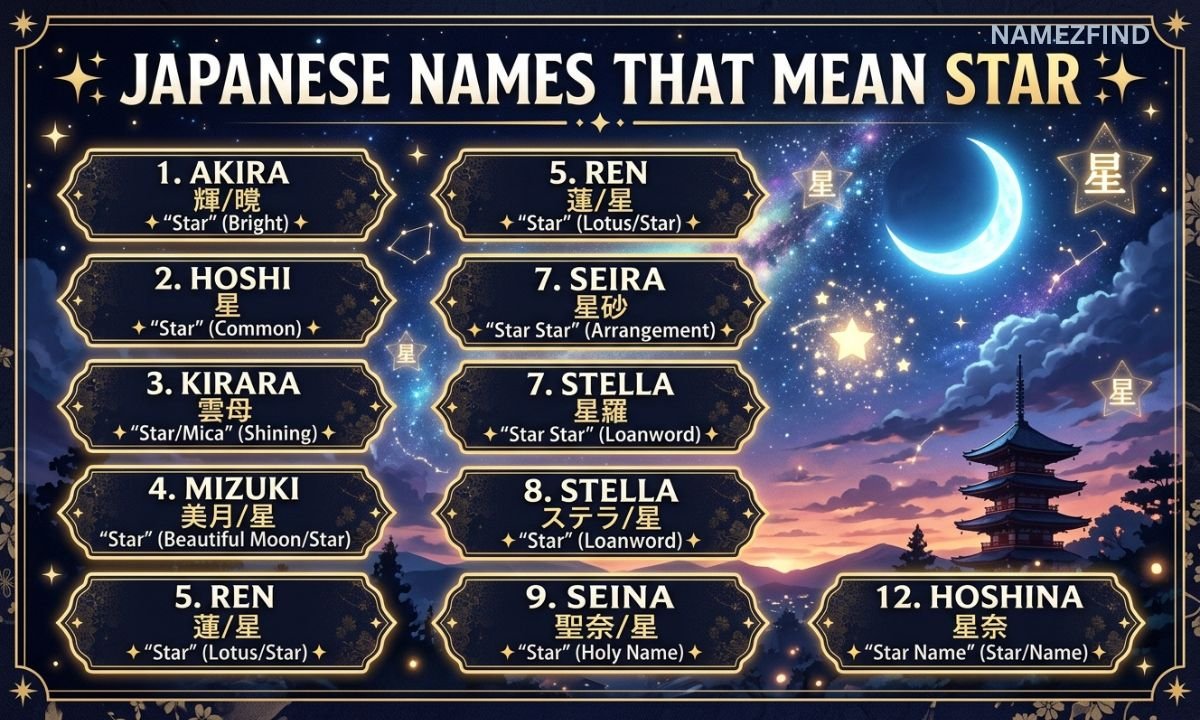
Stars have always caught people’s attention. They shine in the night sky and guide travelers on dark roads. Many parents feel this same wonder when naming their babies. That’s why star names are popular all over the world, including in Japan.
In Japanese culture, the word for star is “hoshi.” This word carries meanings of light, hope, and beauty. Japanese names that mean star often come from different kanji characters. Each kanji can change the sound and deeper meaning of the name.
These star names work well for both boys and girls. Some names use “hoshi” directly, while others use related words like “sei” or “boshi.” Parents often choose these names to wish their child a bright and shining future. In this guide, you will find many beautiful options along with their true meanings and origins.
Japanese Names That Mean Star Generator
⭐ Best Japanese Names That Mean Star
Generate beautiful Japanese names inspired by stars, starlight, the night sky, and celestial beauty.
Japanese Names That Mean Star For Boys
Boy names built around 星 (hoshi/sei) often pair the star kanji with characters for strength, brightness, or nobility, giving them a bold, masculine sound while keeping that celestial meaning front and center.
- Seiya (星哉) – “star” + a literary exclamation particle
- Seiya (星弥) – “star” + “wide-reaching”
- Kousei (光星) – “light star”
- Kousei (煌星) – “sparkling star”
- Issei (一星) – “one star,” meaning a singular, guiding light
- Seito (星斗) – “star” + “Big Dipper”
- Seigo (星吾) – “star” + “myself”
- Seiji (星治) – “star” + “govern, rule”
- Seisuke (星輔) – “star” + “assist, support”
- Seidai (星大) – “star” + “great, large”
- Seihiro (星裕) – “star” + “abundant”
- Hoshio (星生) – “star” + “life, born”
- Subaru (昴) – the Pleiades star cluster
- Kouki (昴輝) – “Pleiades” + “shine”
- Tensei (天星) – “heaven” + “star”
- Seiryu (星龍) – “star dragon”
- Shousei (星翔) – “star soaring”
- Meisei (明星) – “bright star,” also the word for Venus
- Ryuusei (流星) – “shooting star”
- Seitarou (星太郎) – “star” + “eldest son”
- Kirahiko (煌彦) – “sparkling” + “noble young man”
- Seishin (星心) – “star heart”
- Hoshito (星人) – “star person”
- Seima (星真) – “star” + “truth”
- Kagayoshi (輝良) – “shine” + “good”
- Seikou (星幸) – “star” + “happiness”
- Seiki (星輝) – “star” + “radiance”
- Hikaru (光) – “light,” often used for a star-bright son
- Akihoshi (明星) – another reading of “bright star”
- Kanata (彼方) – “the distance/beyond,” often paired with star imagery in names
Japanese Names That Mean Star For Girls
Girl names with the star kanji tend to soften 星 with characters for beauty, flowers, or gentleness, creating delicate, musical names that still shine.
- Seira (星羅) – “star” + “gauze, silk net” (evokes a starry veil)
- Sena (星奈) – “star” + a soft phonetic character
- Hoshiko (星子) – “star child”
- Hoshimi (星美) – “star” + “beauty”
- Seika (星香) – “star” + “fragrance”
- Seina (星菜) – “star” + “greens/vegetable,” a common cute-name pairing
- Serika (星梨花) – “star” + “pear” + “blossom”
- Seri (星莉) – “star” + “jasmine”
- Serin (星凛) – “star” + “dignified, cool”
- Sera (星桜) – “star” + “cherry blossom”
- Hoshie (星恵) – “star” + “blessing”
- Seiori (星織) – “star” + “weave”
- Hoshiba (星羽) – “star” + “feather”
- Seima (星舞) – “star” + “dance”
- Seiyu (星結) – “star” + “bond, tie”
- Hoshine (星音) – “star” + “sound”
- Hoshisa (星彩) – “star” + “color”
- Hoshizuki (星月) – “star moon”
- Hoshimi (星海) – “star sea”
- Kirara (煌々/吉良) – “sparkling, glittering”
- Kirari (煌里) – “sparkle” + “village”
- Akari (明里) – “light/bright” + “village,” a gentle starlit-name cousin
- Suzuho (涼星) – “cool” + “star”
- Sorami (空美) – “sky” + “beauty,” often used alongside star names
- Seira (星来) – “star” + “come,” meaning a star that has arrived
- Hoshina (星菜) – alt reading, “star greens”
- Mieru (見星) – informal, “visible star”
- Sena (聖奈) – phonetic cousin sometimes confused with star Sena
- Hoshika (星佳) – “star” + “excellent, lovely”
- Kohoshi (小星) – “little star”
Unisex Japanese Names That Mean Star
These names work equally well for any child, often because they use the standalone kanji 星 or pair it with neutral, nature-toned characters.
- Hoshi (星) – simply “star,” used for boys and girls alike
- Sei (星) – the on-reading of “star,” short and gender-neutral
- Kirara (煌) – “sparkle, glitter”
- Kira (煌) – short, modern, unisex
- Subaru (昴) – Pleiades, used for any gender
- Hoshito (星登) – “star” + “ascend”
- Seira (星伊良) – flexible reading, “star” + softness
- Hikari (光) – “light,” closely tied to stars
- Akira (晶) – “crystal, sparkle,” often linked with starlight
- Sora (空) – “sky,” frequently paired with star meanings
- Hoshine (星音) – “star sound,” used for both genders in modern naming
- Seigo (星吾) – flexible in modern usage
- Hoshimi (星実) – “star” + “fruit, truth”
- Tsubaru (昴) – alternate soft reading of Subaru
- Hoshika (星花) – “star flower,” used unisex in some families
- Seiwa (星和) – “star” + “harmony”
- Hoshito (星仁) – “star” + “benevolence”
- Kagayaki (輝) – “radiance, shine”
- Reisei (麗星) – “beautiful star”
- Yuusei (優星) – “gentle star”
Unique Japanese Names That Mean Star
For families wanting something rarer than the common Seiya or Hoshiko, these combinations use less-common kanji pairings or archaic readings.
- Seiran (星嵐) – “star storm,” bold and unusual
- Hoshitsuki (星月) – “star moon” read in full
- Seija (星耶) – rare phonetic pairing
- Meiousei (冥王星) – literally “Pluto” (the planet), used as a dramatic unique name
- Kaseki (火星輝) – wordplay on “Mars” + “shine”
- Seiran (聖蘭) – phonetic cousin sometimes mistaken for “star orchid”
- Hoshizora (星空) – “starry sky,” used whole as a given name
- Seito (星兎) – “star rabbit,” referencing moon-and-star folklore
- Kirameki (煌めき) – “twinkling, glittering,” used as a full first name
- Matataki (瞬き) – “a twinkle, a blink”
- Hoshiiro (星色) – “star colored”
- Amahoshi (天星) – “heavenly star,” poetic and uncommon
- Yozora (夜空) – “night sky,” a star-adjacent rare choice
- Seikai (星海) – “star ocean”
- Hoshitaka (星鷹) – “star hawk”
- Seiran (星蘭) – “star orchid”
- Kirahime (煌姫) – “sparkling princess,” rare and ornate
- Hoshimaru (星丸) – “star” + traditional “-maru” boy suffix
Nature Inspired Japanese Names Related To Stars
These names connect stars to the wider natural world — sky, moon, sea, and light — a popular trend in modern Japanese naming.
- Sorahoshi (空星) – “sky star”
- Umihoshi (海星) – “sea star” (also the word for starfish)
- Tsukihoshi (月星) – “moon star”
- Yozora (夜空) – “night sky”
- Amanogawa (天の川) – “heaven’s river,” the Japanese name for the Milky Way
- Hotaru (蛍) – “firefly,” often grouped with star-light names
- Kumohoshi (雲星) – “cloud star”
- Nagareboshi (流れ星) – “shooting star,” used poetically as a name base
- Yuuzora (夕空) – “evening sky”
- Hoshikaze (星風) – “star wind”
- Hoshinami (星波) – “star wave”
- Hoshiyama (星山) – “star mountain”
- Hoshimori (星森) – “star forest”
- Amahoshi (天星) – “heaven’s star”
- Seisui (星水) – “star water”
- Hoshita (星田) – “star field”
- Sorami (空美) – “beautiful sky”
- Tenrei (天麗) – “heavenly beauty,” linked to starlit skies
Cool Japanese Names That Mean Star
For a sharper, edgier sound, these star names lean on strong consonants and dramatic kanji meanings like dragon, storm, or blade.
- Seiryu (星龍) – “star dragon”
- Ryuusei (流星) – “shooting star” (also a popular anime-style name)
- Seijin (星刃) – “star blade”
- Kaisei (雷星) – “thunder star”
- Seiran (星嵐) – “star storm”
- Meiousei (冥王星) – “Pluto,” dark and dramatic
- Kaseisei (火星) – wordplay referencing “Mars”
- Seiga (星牙) – “star fang”
- Seioh (星王) – “star king”
- Hoshimaru (星丸) – traditional samurai-style suffix
- Kurohoshi (黒星) – “black star”
- Seijin (星迅) – “star” + “swift”
- Rakuseiei (落星影) – “falling star shadow,” dramatic invented style
- Seiga (星我) – “star” + “self, ego”
- Kagerou (陽炎星) – “heat-shimmer star,” poetic and cool
Cute Japanese Names That Mean Star
Soft sounds, doubled syllables, and gentle kanji make these picks feel playful and adorable — popular for younger characters and pets too.
- Kirakira (きらきら) – “twinkle twinkle,” used affectionately
- Hoshimaru (星丸) – “little round star,” a cute pet-style name
- Chibihoshi (ちび星) – “tiny star”
- Hoshichan (星ちゃん) – affectionate nickname form
- Poyohoshi – playful invented cute variant
- Hoshimi (星実) – “star fruit,” soft and sweet
- Kirari (きらり) – “a twinkle, a sparkle”
- Hoshiko (星子) – “star child,” classic cute choice
- Momohoshi (桃星) – “peach star”
- Yumehoshi (夢星) – “dream star”
- Coconohoshi – playful modern blended style
- Hoshipyon – whimsical pet-name style
- Hoshimochi (星もち) – “star mochi,” dessert-inspired cute name
- Pukuhoshi – invented soft/cute reading
Best Japanese Names That Mean Star
If you want a shortlist of the most balanced, popular, and easy-to-pronounce star names, these consistently top parent and fan searches.
- Hoshi (星) – timeless and simple
- Seiya (星哉) – classic and widely used
- Kousei (光星) – modern and elegant
- Hoshiko (星子) – graceful for girls
- Subaru (昴) – recognizable and meaningful
- Meisei (明星) – striking, means “bright star”
- Seira (星羅) – soft, popular for girls
- Ryuusei (流星) – dynamic and energetic
- Hikari (光) – simple, luminous meaning
- Kirara (煌) – trendy and sparkly
- Seiji (星治) – strong, traditional boy name
- Sena (星奈) – gentle and modern
- Yuusei (優星) – “gentle star,” a rising favorite
Funny Japanese Names That Mean Star
These are lighthearted, pun-based, or exaggerated star names best used for characters, pets, or inside jokes rather than formal naming.
- Hoshizamurai (星侍) – “star samurai,” playfully dramatic
- Poteto Hoshi – “potato star,” a jokey mash-up
- Hoshimochimochi – silly doubled cuteness
- Doraboshi – playful riff combining “star” with common nicknames
- Hoshikorokoro – “tumbling star,” a giggly sound-based name
- Meiousei-kun – informally using “Pluto” as a nickname
- Boshiboshi – repeated playful reading of “star”
- Hoshipenguin – whimsical animal-star mashup for pets
- Ossei – a jokey shortened “star” nickname
- Hoshidon – food-pun style nickname (“star” + “don,” a rice bowl dish)
Female Japanese Names That Mean Star
- Seira (星羅)
- Hoshiko (星子)
- Seika (星香)
- Hoshimi (星美)
- Serika (星梨花)
- Sera (星桜)
- Seiori (星織)
- Hoshine (星音)
- Kirara (煌)
- Hoshika (星佳)
- Seira (星来)
- Hoshisa (星彩)
- Sena (星奈)
- Seiyu (星結)
- Hoshie (星恵)
Male Japanese Names That Mean Star
- Seiya (星哉)
- Kousei (光星)
- Issei (一星)
- Subaru (昴)
- Seito (星斗)
- Ryuusei (流星)
- Meisei (明星)
- Seiryu (星龍)
- Seitarou (星太郎)
- Hoshio (星生)
- Seigo (星吾)
- Seiji (星治)
- Tensei (天星)
- Yuusei (優星)
- Kouki (昴輝)
Common Mistakes To Avoid In Japanese Names That Mean Star
Choosing a Japanese name that means star is exciting, but a few common missteps trip people up:
- Assuming every “sei” or “hoshi” name means star. Both readings are used for many other kanji (清, 誠, 星 vs. 生, 世), so always check the actual character, not just the sound.
- Ignoring kanji choice. The same reading, like Seiya, can be written with different kanji that change the meaning entirely — always confirm which characters carry the “star” meaning you want.
- Overusing anime-inspired names without context. Names like Seiya or Ryuusei are strongly associated with pop culture; that’s fine, but be aware of the association if you want a more traditional feel.
- Mixing incompatible kanji. Not every “star” kanji pairs naturally with every other character — some combinations read awkwardly or unnaturally to native speakers.
- Forgetting gender conventions. Certain star-kanji endings (like -ko, -mi, -ka) read as feminine, while others (-ya, -ta, -go) read as masculine; unisex names usually stick to single kanji like 星 or 昴.
- Skipping pronunciation checks. Some elegant-looking kanji combinations have multiple possible readings, which can cause confusion on official documents.
- Translating literally instead of naturally. A name that means “shooting star” in English doesn’t always translate to a real, usable Japanese name — always verify with a native speaker or naming resource.
- Not considering stroke count and numerology. Traditional Japanese naming (seimei handan) considers kanji stroke counts for luck; many parents check this before finalizing a star-themed name.
- Choosing overly rare kanji. Extremely uncommon characters may not be recognized by Japanese family registry systems (koseki), so double-check legal usability if the name is for real-world registration.
Whether you’re drawn to the boldness of Seiryu, the softness of Hoshiko, or the simplicity of Hoshi itself, Japanese names that mean star offer a beautiful way to carry the night sky’s wonder into everyday life.
FINAL THOUGHTS
Choosing a name is a special task. It stays with your child for life. Japanese names that mean star carry deep beauty and meaning. They connect your child to light, hope, and wonder.
Each name on this list has its own story. Some come from old traditions. Others use modern kanji choices. No matter which one you pick, it will feel meaningful and unique.
Star names work well for both boys and girls. You can pick a strong sound or a soft one. You can also choose the kanji that fits your family’s values best. This makes the naming process personal and fun.
We hope this guide helped you find the right name. A star name can be a beautiful gift for your child. It may inspire them to shine bright in their own life. Take your time and choose the name that feels right for you.
FAQs
Japanese Names That Start With R With Strong Meanings
Names like Ryuu (龍, “dragon”), Ren (蓮, “lotus”), and Ryouta (亮太, “clear/bold”) carry bold, powerful meanings tied to strength, nature, and clarity. They’re popular for boys wanting a name that sounds both modern and commanding.
Best Japanese Names That Mean Blood (Unique Picks)
Names directly meaning “blood” (血, ketsu/chi) are rare in Japanese naming since the kanji is considered inauspicious; instead, parents pick softer alternatives with the “chi” sound paired with positive characters (e.g., 千, “thousand”). True “blood” names are mostly found in fiction or symbolic character naming, not everyday use.
720+ Japanese Names That Start With M (With Meanings)
Popular “M” names include Mizuki (美月, “beautiful moon”), Minato (湊, “harbor”), Miyu (美優, “beautiful/gentle”), and Masaru (勝, “victory”), spanning boys, girls, and unisex options. The letter M is one of the most common name-starters in Japanese, offering huge variety across nature, virtue, and beauty themes.
Powerful Japanese Names That Mean Warrior For Strength
Names like Takeshi (武, “warrior/military”), Tsuyoshi (強, “strong”), and Yuuki (勇気, “courage”) directly reference martial strength and bravery. These are classic choices for boys meant to embody resilience and fighting spirit.
What is star child in Japanese?
“Star child” translates roughly to Hoshiko (星子) for girls or Hoshimaru (星丸) in a more traditional boy’s style, both literally meaning “child of the star.” Hoshiko is the most commonly used real-world version of this concept.
What Japanese name means “galaxy”?
Ginga (銀河) is the Japanese word for “galaxy,” literally meaning “silver river,” and is sometimes used directly as a boy’s given name. It evokes the Milky Way and vast cosmic scale.
What Japanese name means “sky”?
Sora (空) is the most common Japanese name meaning “sky,” used for both boys and girls. Variants like Sorano (空乃) or Yozora (夜空, “night sky”) extend the same theme.
What is bright star in Japanese?
Meisei (明星) means “bright star” and is also the traditional word for the planet Venus. It’s used as a striking, meaningful given name, often for boys.

Hi, I’m CH Zahid, the founder of NamezFind. I created this website to help people find names that are meaningful, easy to search, and simple to understand. My goal is to make your search for the perfect name quick and enjoyable.