
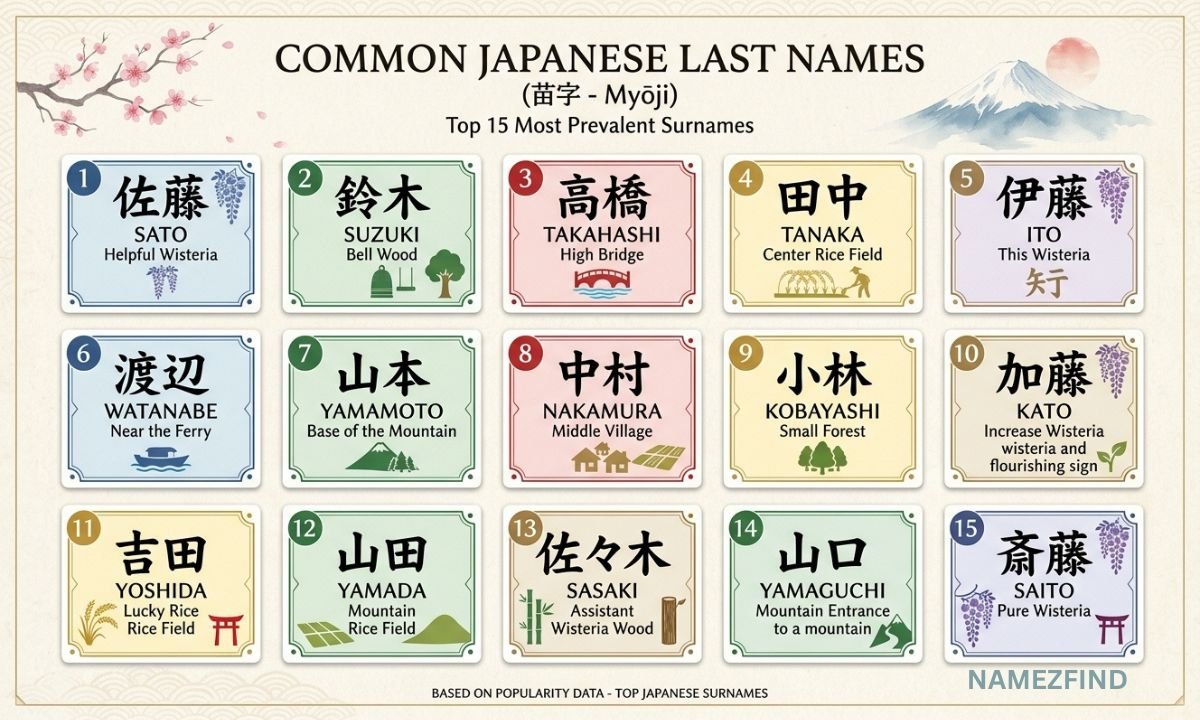
Japanese last names carry deep meaning. Most of them come from nature, places, or old family jobs. People started using surnames widely only after 1868, during the Meiji era. Before that, only samurai and nobles had family names.
Every Japanese last name tells a small story. Some names point to where a family once lived, like near a mountain or river. Others describe a family trade, such as farming or fishing. This is why so many surnames feel connected to nature and daily life.
Today, some last names are more common than others across Japan. Names like Sato, Suzuki, and Takahashi appear at the top of most rankings. Knowing these names helps you understand Japanese culture better. It also makes it easier to recognize patterns when you come across new names.
Quick Checklist Before Choosing a Japanese Last Name
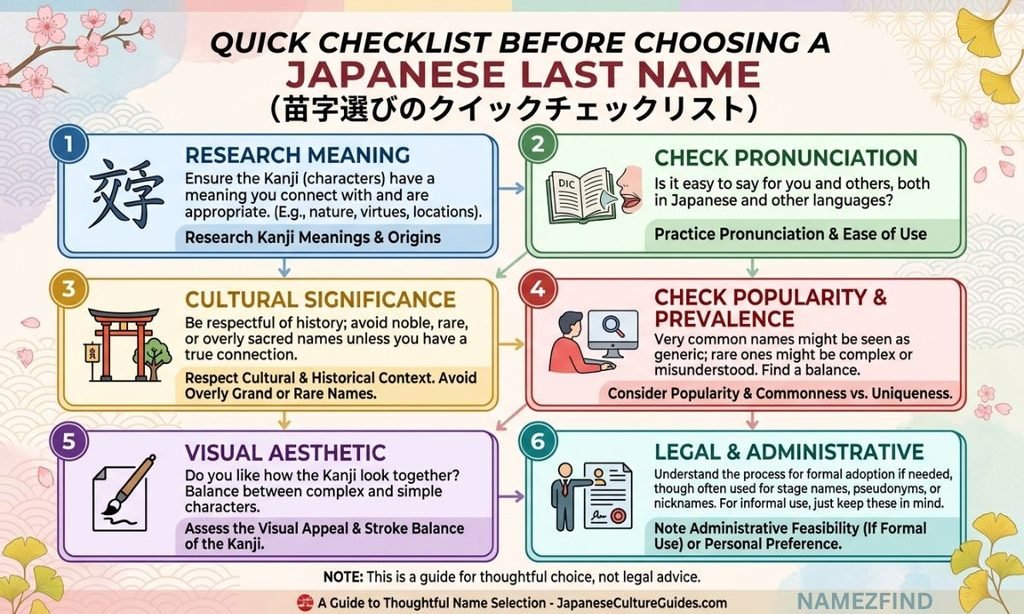
Before picking a Japanese last name, it helps to slow down and think it through. A name should sound natural, carry a meaning you like, and fit the purpose you have in mind, whether that’s a character, a pen name, or a gaming handle.
- Check the meaning behind the kanji, not just the sound
- Make sure it’s easy to pronounce for your audience
- Decide if you want a common name or a rare one
- Think about whether it fits a male, female, or neutral character
- Avoid names tied only to real, well-known families without reason
- Pair it with a first name to see how it flows together
- Search it online to see how it’s already being used
Japanese Last Names Generator
🇯🇵 Japanese Last Names Generator
Generate beautiful, traditional, unique, and authentic Japanese last names instantly.
A Japanese last name generator is a quick tool for writers, gamers, and parents-to-be who want fresh name ideas in seconds. Instead of researching for hours, you get a random mix of real and realistic-sounding surnames instantly.
- Sato
- Suzuki
- Takahashi
- Tanaka
- Watanabe
- Ito
- Yamamoto
- Nakamura
- Kobayashi
- Kato
- Yoshida
- Yamada
- Sasaki
- Yamaguchi
- Saito
- Matsumoto
- Inoue
- Kimura
- Hayashi
- Shimizu
- Mori
- Ikeda
- Hashimoto
- Ishikawa
- Ogawa
- Goto
- Okada
- Fujita
- Nakagawa
- Kondo
Japanese Last Names
Japanese last names are a mix of nature, geography, and old family roles. Most surnames use two kanji characters, and each character adds its own layer of meaning. This combination is what makes Japanese names feel so rich and varied.
- Abe
- Aoki
- Endo
- Fujiwara
- Hara
- Honda
- Ishii
- Kaneko
- Kudo
- Maeda
- Miura
- Miyamoto
- Murakami
- Nishimura
- Noguchi
- Ozawa
- Sakamoto
- Sugiyama
- Takeda
- Ueda
Common Japanese Last Names
Common Japanese last names are the ones you’ll hear most often in daily life, school, or work in Japan. They’re common because large family lines spread across generations and regions over hundreds of years.
- Sato
- Suzuki
- Takahashi
- Tanaka
- Watanabe
- Ito
- Yamamoto
- Nakamura
- Kobayashi
- Kato
- Yoshida
- Yamada
- Sasaki
- Yamaguchi
- Saito
- Matsumoto
- Inoue
- Kimura
- Hayashi
- Shimizu
Japanese Last Names and Meanings
Every Japanese surname has a meaning rooted in its kanji characters. Learning these meanings makes names feel personal instead of just a string of sounds.
- Tanaka – “middle of the rice field”
- Yamamoto – “base of the mountain”
- Kawaguchi – “mouth of the river”
- Nakagawa – “middle river”
- Ishikawa – “stone river”
- Fujimoto – “base of the wisteria”
- Morita – “forest rice field”
- Takagi – “tall tree”
- Ogawa – “small river”
- Hayashi – “forest” or “woods”
- Matsuda – “pine field”
- Shimizu – “clear water”
- Kimura – “tree village”
- Iwamoto – “base of the rock”
- Yamashita – “below the mountain”
Popular Japanese Last Names
Popular Japanese last names are widely recognized both in Japan and internationally, often thanks to media, sports, and pop culture. These names feel familiar even to people outside Japan.
- Sato
- Suzuki
- Tanaka
- Watanabe
- Yamamoto
- Nakamura
- Kobayashi
- Yamada
- Saito
- Sasaki
- Matsumoto
- Inoue
- Kimura
- Shimizu
- Hasegawa
- Kojima
- Yoshikawa
- Nishida
- Fukuda
- Miyazaki
Traditional Japanese Last Names
Traditional Japanese last names often trace back to samurai families, ancient clans, or old imperial connections. These surnames carry a stronger sense of history and formality.
- Minamoto
- Taira
- Fujiwara
- Tokugawa
- Ashikaga
- Oda
- Hojo
- Date
- Uesugi
- Shimazu
- Mori
- Chiba
- Takeda
- Imagawa
- Sanada
Unique Japanese Last Names
Unique Japanese last names stand out because they’re rare, unusual in sound, or based on less common kanji combinations. They work well for characters or brands that need to feel distinctive.
- Tsukioka
- Kazahaya
- Hoshikawa
- Kirisame
- Amasawa
- Yozora
- Kurenai
- Shirogane
- Rindo
- Tsukimori
- Akatsuki
- Yugure
- Kagerou
- Mizuhara
- Kotone
Japanese Last Names for Girls
Japanese last names for girls often pair well with soft, graceful first names. While surnames themselves aren’t gendered in Japanese, some sound gentler and suit feminine character names.
- Sakura
- Hoshino
- Fujiwara
- Kanzaki
- Shirakawa
- Tsukishima
- Momoi
- Yukimura
- Hanamura
- Kotobuki
- Amane
- Mizusawa
- Karin
- Aihara
- Kinjo
Japanese Last Names for Boys
Japanese last names for boys often sound strong and grounded, pairing naturally with bold first names. Many come from mountains, warriors, or old clan names.
- Takeda
- Kurogane
- Yamazaki
- Nishikawa
- Fujimura
- Kaito
- Ryusei
- Tategami
- Kagemori
- Susumu
- Genzo
- Hidaka
- Masamune
- Katsuragi
- Shibata
Japanese Last Names & Their Meanings
Understanding the meanings behind Japanese surnames adds depth when choosing a name for a story, character, or personal project. Many are tied directly to geography and nature.
- Nakamura – “middle village”
- Kobayashi – “small forest”
- Yoshida – “lucky rice field”
- Sasaki – “shallow ravine”
- Yamaguchi – “mouth of the mountain”
- Inoue – “above the well”
- Hashimoto – “base of the bridge”
- Ikeda – “pond field”
- Ogata – “small shape/area”
- Kondo – “near hall/temple”
Japanese Last Names Male (2000s)
Japanese last names that felt popular and modern during the 2000s often show up in anime, manga, and pop culture from that era. They carry a slightly modern feel compared to older, more historical names.
- Aoyama
- Kuroba
- Hattori
- Edogawa
- Kudo
- Amuro
- Sakuragi
- Tsukishiro
- Ranmaru
- Kaito
- Toudou
- Kururugi
- Amagi
- Souma
- Yagami
Cute Japanese Last Names
Cute Japanese last names have a light, playful sound that works well for younger characters, pets, or casual online usernames. They tend to be short and soft-sounding.
- Momo
- Usagi
- Koharu
- Hinata
- Kotori
- Mimura
- Nono
- Chiyo
- Fuwa
- Ponta
- Mochizuki
- Kohana
- Suzu
- Maru
- Chibi
Good Japanese Last Names
A “good” Japanese last name usually means one that sounds balanced, has a positive meaning, and is easy to say. These names work well across most uses, from writing to naming.
- Yoshida – “good fortune field”
- Fukuda – “lucky field”
- Kotobuki – “long life/celebration”
- Masuda – “increasing field”
- Kichijoji-style names carrying “luck” kanji
- Terada – “temple field”
- Hisamatsu – “eternal pine”
- Yasuda – “peaceful field”
- Anzai – “peaceful west”
- Shofuku – “true fortune”
Japanese Last Names with Dark Meanings
Some Japanese surnames use kanji tied to shadows, night, or intense imagery, which makes them popular for dramatic or mysterious characters. These aren’t inherently negative in Japanese culture, but the imagery feels bold.
- Kurogane – “black metal”
- Yamikawa – “dark river”
- Kuroyama – “black mountain”
- Kage – “shadow”
- Ankoku – “darkness”
- Karasu – “crow”
- Kurotani – “black valley”
- Yoru – “night”
- Hitogata – “human shape/effigy”
- Kuroi – “black”
Japanese Last Names Meaning Star
Star-related Japanese surnames use the kanji for “hoshi,” meaning star, often combined with sky or light imagery. These names feel poetic and are common in fiction.
- Hoshino – “star field”
- Hoshikawa – “star river”
- Hoshizaki – “star peninsula”
- Akaboshi – “red star”
- Hoshiyama – “star mountain”
- Kirihoshi – “mist star”
- Hoshizora – “starry sky”
- Sekihoshi – “stone star”
- Hoshimori – “star forest”
- Ginboshi – “silver star”
Male Japanese Last Names
Male-leaning Japanese last names often sound firm and strong, and are commonly paired with traditional male first names in fiction and real life alike.
- Takahashi
- Watanabe
- Kimura
- Takeda
- Fujimoto
- Nishikawa
- Kurosawa
- Okamoto
- Shibata
- Uchida
- Miyamoto
- Sugawara
- Kaneda
- Arakawa
- Tsuchiya
Female Japanese Last Names
Female-leaning Japanese last names tend to sound softer, often pairing well with gentle, flowing first names in stories or naming projects.
- Fujiwara
- Kanzaki
- Shiraishi
- Hanazono
- Mizuki
- Amemiya
- Kotobuki
- Shirasaki
- Momose
- Sakuragi
- Aihara
- Karasawa
- Kinoshita
- Otonashi
- Yukishiro
Rare Japanese Last Names
Rare Japanese last names are uncommon because they belong to small family lines or specific regions. They stand out precisely because so few people share them.
- Ryumon
- Kirihara
- Tsukumo
- Amatsuki
- Kagayaki
- Yozora
- Tokishima
- Kurenai
- Amagatsu
- Shirogane
- Hyoudou
- Tsukikage
- Ranmaru
- Kotobukiyama
- Yamikaze
Japanese Last Names on Social Media
Japanese-style last names are popular for social media handles because they sound cool, mysterious, or aesthetic even to non-Japanese speakers. People often combine them with English first names for a unique username.
- Kuro
- Yuki
- Ren
- Hana
- Kaze
- Tsuki
- Sora
- Ryuu
- Akira
- Hikari
- Rin
- Kage
- Mizu
- Hoshi
- Yami
Japanese Last Names Meaning Moon
Moon-related surnames use the kanji “tsuki,” giving them a calm, poetic quality. These are favorites in anime, novels, and creative naming projects.
- Tsukishima – “moon island”
- Tsukioka – “moon hill”
- Mochizuki – “full moon”
- Tsukimori – “moon forest”
- Tsukikage – “moonlight/shadow”
- Tsukimura – “moon village”
- Yuzuki – “gentle moon”
- Tsukiyama – “moon mountain”
- Tsukigase – “moon rapids”
- Tsukisaka – “moon slope”
Japanese Last Names Meaning Love
Love-related surnames use kanji like “ai” or “koi,” giving them a warm, affectionate feel. They’re often chosen for romantic characters or heartfelt naming projects.
- Aihara – “love field”
- Aizawa – “love marsh”
- Koizumi – “love spring”
- Aimoto – “base of love”
- Aikawa – “love river”
- Airi – “love village”
- Aida – “between love/love rice field”
- Aiba – “love horse/field”
- Aishima – “love island”
- Aimura – “love village”
Japanese Last Names Meaning Death
A few surnames use kanji connected to endings, spirits, or the afterlife, giving them a heavier tone. These are rare in real life but appear often in dark fiction.
- Shineku (fictional-style, “death” root)
- Meifu – “underworld”
- Reikon – “soul/spirit”
- Yūrei – “ghost”
- Shikabane – “corpse” (used mainly in fiction)
- Meido – “realm of the dead”
- Kanashimi – “sorrow”
- Owari – “the end”
- Kuroyuri – “black lily,” linked to mourning
- Shide – “paper death charm,” used symbolically in fiction
Japanese Last Names Website
If you want to explore Japanese last names further, dedicated naming websites offer searchable databases, kanji breakdowns, and generators. These sites are useful for writers, parents, and anyone curious about surname origins.
- Look for sites with kanji meaning breakdowns
- Choose ones that show regional popularity data
- Use sites offering audio pronunciation
- Cross-check meanings across two or more sources
- Bookmark sites that update their name lists regularly
Japanese Last Names with Beautiful Meanings
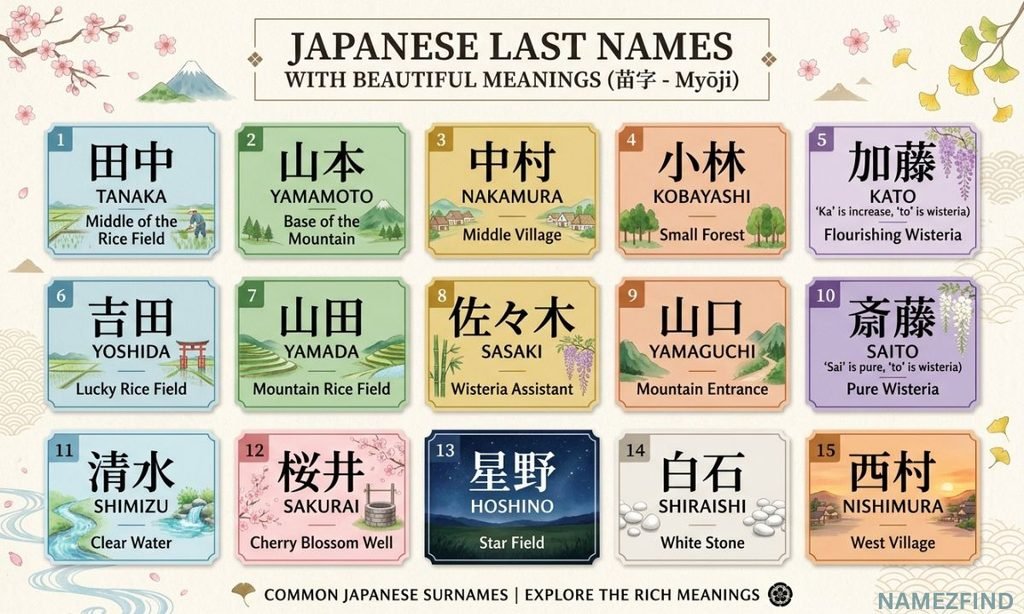
Some Japanese surnames sound beautiful both in pronunciation and in meaning, often referencing flowers, seasons, or peaceful imagery.
- Hanamura – “flower village”
- Sakuragi – “cherry blossom tree”
- Kotone – “sound of the harp”
- Harumi – “beautiful spring”
- Akikawa – “autumn river”
- Yukihira – “snow peace”
- Fuyumi – “beautiful winter”
- Shizuka – “quiet/calm”
- Midorikawa – “green river”
- Kirameki – “sparkle/glitter”
How We Create Japanese Last Names
Creating a Japanese last name usually starts with picking meaningful kanji and combining them in a way that sounds natural. This process blends language rules with personal or creative intent.
- Start with a nature word (river, mountain, forest)
- Add a location word (field, village, base, peak)
- Check how the combined kanji sound together
- Confirm the reading isn’t already an unrelated real word
- Test the name with different first names for flow
- Get feedback from someone familiar with Japanese, if possible
Tips for Making Your Japanese Last Names Stand Out
A great Japanese last name balances sound, meaning, and originality. A few small adjustments can turn an average name into a memorable one.
- Pick a meaning that reflects the character or purpose
- Avoid overused names if you want something unique
- Keep pronunciation simple for a wider audience
- Pair it with a first name that has a contrasting rhythm
- Research real usage so the name doesn’t feel forced
- Test it out loud before finalizing your choice
FINAL THOUGHTS
Japanese last names are more than just labels. They carry history, meaning, and a sense of identity. Learning about them gives you a small window into Japanese culture. It shows how closely names, nature, and daily life are connected.
Every surname has a story behind it. Some names come from old villages or landscapes. Others come from family trades passed down for generations. This makes Japanese last names feel personal and rooted in real life.
Rankings also help us see bigger patterns. Common names like Sato or Suzuki show how families spread across regions. Rare names, on the other hand, often point to smaller or older family lines. Both types add depth to Japan’s naming traditions.
In the end, Japanese last names reflect more than identity. They connect people to their ancestors, their land, and their history. Whether common or rare, each name holds a small piece of the past. That’s what makes exploring them so interesting.
FAQs
What is the rarest Japanese last name?
Some of the rarest Japanese last names, like Kunidori or Ryuguzaki, are held by only one or two families in the entire country. These names often survive in a single village or region, making them almost undocumented outside local records.
What are good Japanese last names?
Good Japanese last names are ones that sound balanced and carry a positive meaning, like Yoshida (“lucky field”) or Fukuda (“fortunate field”). They work well because they’re easy to pronounce and feel pleasant in everyday use.
What is an old Japanese last name?
Old Japanese last names often come from samurai or noble clans, such as Minamoto, Taira, or Fujiwara. These names date back over a thousand years and were originally reserved for the ruling and warrior classes.
What are the 10 most common surnames in Japan?
The most common Japanese surnames are Sato, Suzuki, Takahashi, Tanaka, Watanabe, Ito, Yamamoto, Nakamura, Kobayashi, and Kato. Together, these ten names are shared by a huge portion of Japan’s population.
What is a nameless Japanese name?
A “nameless” Japanese name usually refers to Mumei, meaning “without a name” or “unknown.” It’s often used symbolically in fiction for mysterious or origin-less characters rather than as a real family surname.
What is an extremely rare last name?
An extremely rare last name is one held by fewer than a handful of people nationwide, such as Kadowaki or Tsukumogami-style names. These surnames are so uncommon that many Japanese people have never encountered them.
What is a very rare Japanese name?
Very rare Japanese names, like Kokuryu or Hyakume, exist in tiny numbers and are usually tied to a single ancestral village. Their rarity makes them stand out instantly whenever they appear on official records.
What is the longest Japanese surname?
Longer Japanese surnames often use four or more kanji characters, such as Kannaduki or Ōkitsushima-style names found in old records. In everyday romanization, these can stretch to ten or more letters, much longer than typical two-kanji surnames.
What are some unisex Japanese names?
Unisex Japanese surnames like Aoki, Mori, or Hoshi work equally well for any character or person since surnames in Japan aren’t gender-specific. This makes them flexible for naming projects that need a neutral tone.
What are some mysterious Japanese last names?
Mysterious-sounding Japanese last names, such as Kagerou, Yozora, or Tsukikage, use kanji tied to shadows, night skies, and shifting light. These names feel poetic and are popular choices for enigmatic fictional characters.

Hi, I’m CH Zahid, the founder of NamezFind. I created this website to help people find names that are meaningful, easy to search, and simple to understand. My goal is to make your search for the perfect name quick and enjoyable.