
Have you ever heard a name and wondered what it really means? Names carry meaning, history, and culture behind them. Employer Name is one such name that has a rich background. In this article, we will explore its meaning, history, and correct pronunciation.
Every name has a story. Employer Name is not just a word, it is a part of someone’s identity. Understanding its meaning helps us connect with its roots. It also shows how language and culture shape the names we use today.
The history of Employer Name goes back many years. Names often change over time due to migration, language mixing, and cultural influence. Employer Name has traveled through different regions and communities. This journey has added new layers of meaning to it.
Pronunciation is just as important as meaning. Saying a name correctly shows respect to its origin. Many people mispronounce names simply because they are unfamiliar with them. In this guide, we will make sure you learn to say Employer Name the right way.
Employer Name Meaning Generator
💼 Employer Name Generator
Generate professional, creative, modern, and memorable employer names instantly.
What Does Employer Name Mean
Your employer name is simply the legal or trading name of the company, organization, or individual who pays your salary or wages. It’s the entity that issues your paycheck and appears on your official work records.
- The registered legal name of the business you work for
- Can be a company, non-profit, government body, or individual
- Different from your job title or department name
- Used to verify employment across forms and applications
Employer Name in Job Applications
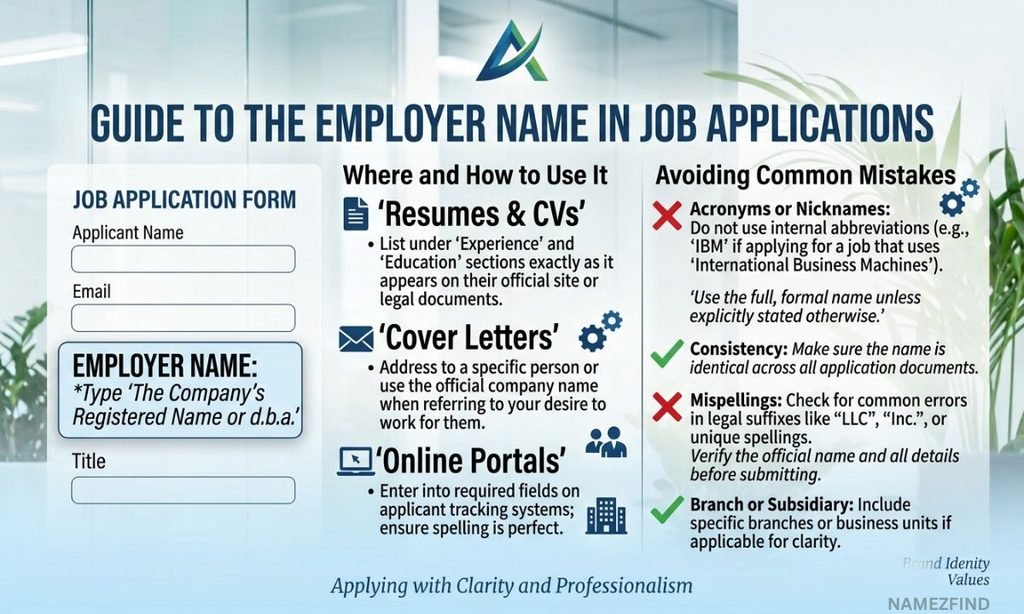
Recruiters use your employer name to verify your work history and check references. Getting it exactly right avoids delays in hiring.
- Always use the full legal or commonly known trading name
- Match the name exactly as it appears on your payslip or offer letter
- Avoid abbreviations unless they’re the company’s official short form
- Include past and current employer names in the work history section
Employer Name in Banking and Finance
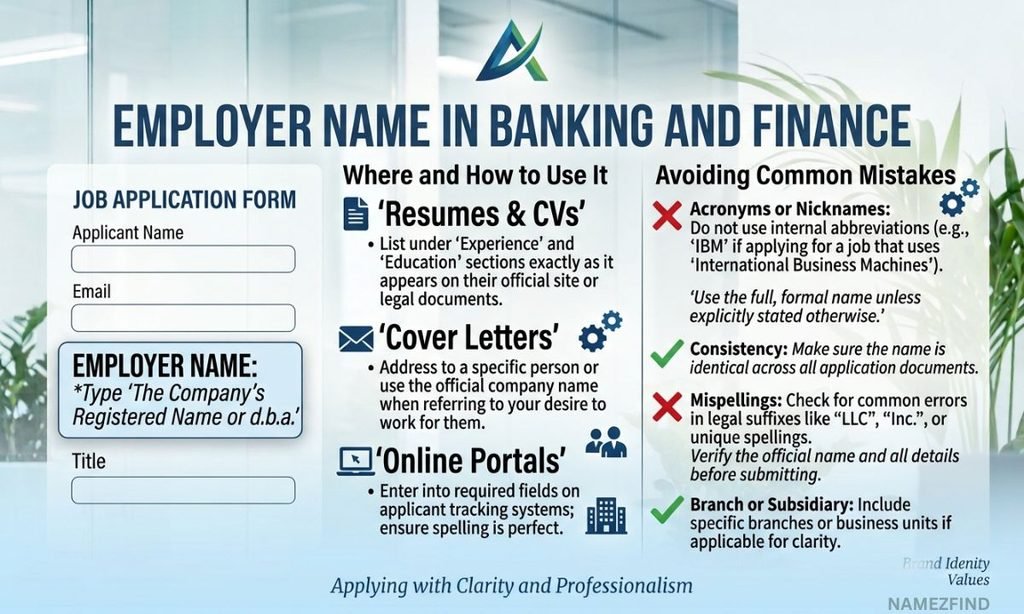
Banks request your employer name to assess income stability for loans, credit cards, and account approvals.
- Required for loan and mortgage applications
- Used to verify income source during credit checks
- Helps banks assess employment stability
- Must match payroll records to avoid verification issues
Employer Name in Payroll and HR Systems
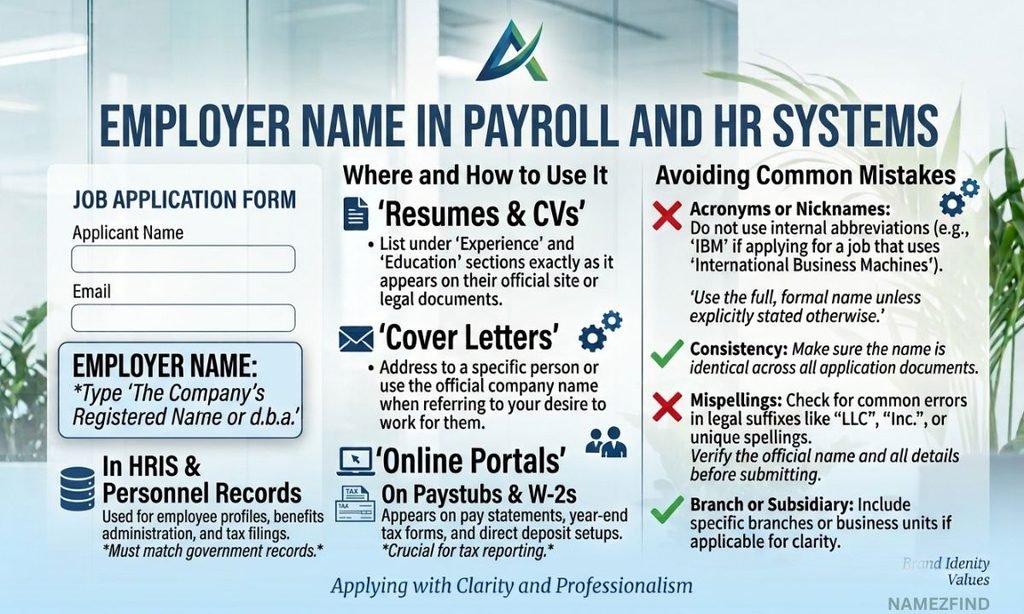
HR and payroll teams rely on the employer name to generate accurate pay stubs, tax filings, and compliance records.
- Appears on payslips, contracts, and internal HR records
- Used for payroll tax reporting and compliance
- Must match the registered business entity name
- Errors here can cause tax filing mismatches
Employer Name for Self-Employed Individuals
If you’re self-employed, your “employer name” is usually your own business name or your legal name as a sole proprietor.
- Freelancers can list their business name or “Self-Employed”
- Sole proprietors often use their own legal name
- Registered businesses should use their official trade name
- Consistency matters for tax and loan applications
Employer Name in Tax Documents
Tax authorities use employer name to match income reported by employers with individual tax returns.
- Found on W-2, 1099, or equivalent tax forms
- Must match the employer’s registered tax ID name
- Mismatches can trigger audits or delayed refunds
- Always cross-check with official payroll documents
Employer Name in Resume
On a resume, employer name establishes credibility and helps recruiters quickly identify where you’ve worked.
- List the full, official company name for each role
- Avoid nicknames or internal project names
- Include company name even for internships or part-time work
- Keep formatting consistent across all listed employers
Employer Name for Student
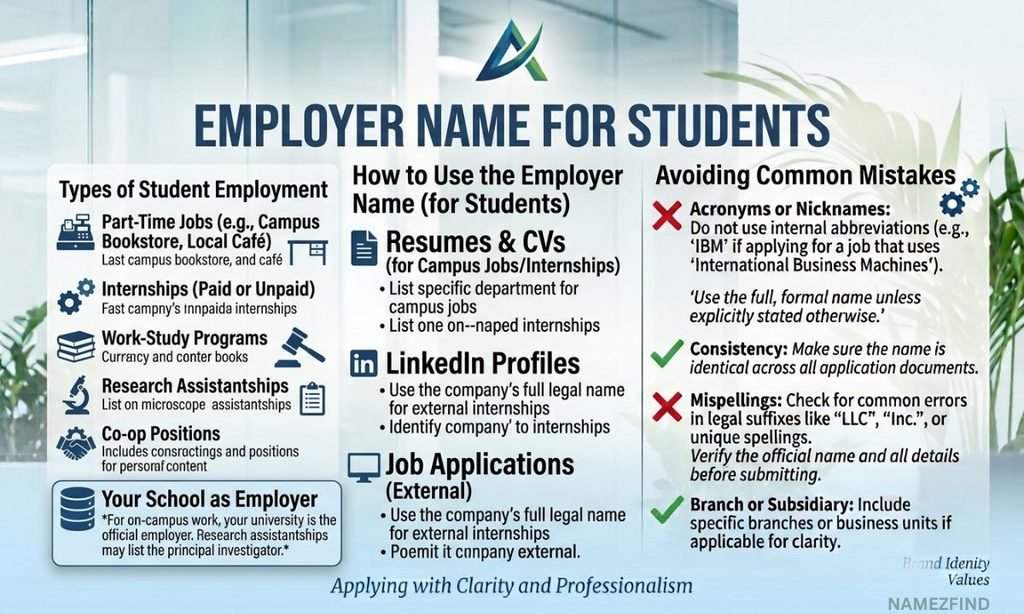
Students working part-time or during internships still need to correctly record their employer name for tax and application purposes.
- Use the official name of the school, company, or organization
- Applies to campus jobs, internships, and part-time work
- Needed for scholarship or financial aid verification
- Keep records for future resume and tax use
Employer Name List
An employer name list is simply a record of every organization you’ve worked for, often required for background checks or loan applications.
- Include company name, dates, and job title for each entry
- List employers in reverse chronological order
- Add contact details if requested by verifiers
- Keep the list updated with each new job change
Employer Name in Immigration and Visa Applications
Immigration authorities use employer name to verify sponsorship, work eligibility, and employment legitimacy.
- Required for work visas and sponsorship applications
- Must match the sponsoring company’s legal registration
- Used to confirm job offer authenticity
- Errors can delay or jeopardize visa approval
Employer Name for Students and Interns
Interns and student workers should treat employer name with the same accuracy as full-time employees, since it affects references and records.
- Use the full organizational name, not department nicknames
- Confirm the correct name with HR before submitting forms
- Important for future employment verification
- Helps build a credible early work history
Employer Name in Background Checks
Background check companies verify employer name against official business registries to confirm your work history is genuine.
- Must match public business registration records
- Discrepancies can flag a background check as inconsistent
- Verifiers often contact HR using the listed employer name
- Accurate naming speeds up the verification process
Employer Name in Health and Insurance Forms
Insurance providers use employer name to confirm group coverage eligibility and process claims correctly.
- Needed for employer-sponsored health insurance enrollment
- Confirms eligibility for group insurance plans
- Used to coordinate benefits between insurer and employer
- Should match payroll and HR records exactly
Employer Name in Legal Contracts
In legal contracts, employer name identifies the responsible party and ensures the agreement is enforceable.
- Must reflect the legally registered business entity
- Used in employment contracts, NDAs, and agreements
- Incorrect naming can create enforceability issues
- Always verify against official incorporation documents
Employer Name in Government Registrations
Government agencies use employer name for tax registration, labor compliance, and official record-keeping.
- Required for business tax ID and labor registrations
- Used in unemployment and social security filings
- Must match the entity’s official registration certificate
- Ensures compliance with local labor laws
Employer Name Example
A clear example helps illustrate how employer name should be written across different contexts.
- Correct: “ABC Technologies Pvt Ltd” (full legal name)
- Incorrect: “ABC Tech” (informal abbreviation)
- Self-employed example: “Self-Employed – Freelance Graphic Designer”
- Government example: “City of Springfield – Public Works Department”
Employer Name is Company Name
In most cases, employer name and company name refer to the same thing — the business entity you work for.
- Employer name usually equals the registered company name
- Both should match business registration documents
- Sole proprietors may use their personal name instead
- Consistency avoids confusion in official paperwork
Is Employer Name the Company or Person
Employer name typically refers to the company, though for small businesses or self-employment, it can be an individual’s name.
- Company employees: employer name is the business entity
- Self-employed: employer name may be the individual’s own name
- Domestic staff or personal hires: often the employing individual’s name
- Always check the specific form’s requirements
Common Mistakes with Employer Name
Small errors in employer name can cause big delays in applications, tax filings, and verifications.
- Using nicknames instead of the official registered name
- Misspelling or abbreviating the company name inconsistently
- Confusing employer name with department or manager name
- Forgetting to update employer name after a job change
FINAL THOUGHTS
Names hold more meaning than we often realize. Employer Name is a great example of this. It carries history, culture, and identity all in one word. We hope this article helped you understand it better.
Learning about a name’s meaning makes it feel more personal. Employer Name is not just letters put together. It has roots, stories, and a journey behind it. Knowing this makes the name even more special.
Pronunciation matters just as much as meaning. Saying Employer Name correctly shows care and respect. It also helps avoid confusion in daily conversations. A small effort in pronunciation goes a long way.
In the end, every name deserves to be understood properly. Employer Name is a name with depth and value. We hope this guide gave you clear and simple answers. Feel free to share it with others who are curious too.
FAQs
What is an employer name?
An employer name is the official name of the company or person who hires and pays a worker. It appears on job forms, pay slips, and tax documents.
What is an example of an employer?
An employer can be a company like “ABC Technologies Pvt Ltd” or an individual business owner. Both are responsible for hiring and paying employees.
What is an example of an employee name?
An employee name is simply the worker’s own name, such as “John Smith” or “Ayesha Khan.” It identifies the person doing the job, not the company.
What is employer in a CV?
In a CV, the employer refers to the company or organization you worked for in each job listed. It is usually written under your work experience section.
What is an employer?
An employer is a person, company, or organization that hires workers and pays them a salary or wage. They are responsible for job duties, pay, and workplace rules.
What is the meaning of “employer” in Urdu?
In Urdu, “employer” is called آجر (Aajir) or مالک (Malik), meaning the one who employs and pays workers. It refers to the person or company giving the job.
What to put as an employer name?
You should put the official registered name of the company or business you work for. If self-employed, you can write your own name or business name.
Who is employer vs employee?
An employer is the one who hires and pays for work, while an employee is the person who performs the job. Employers manage; employees carry out tasks under them.
Who is a current employer?
A current employer is the company or person you are presently working for. It refers to your active, ongoing job at the time of application.
Can you give me an example of an employer name?
Sure, an example of an employer name could be “XYZ Retail Store” or “Self-Employed.” It should match the official name used in business records.
What is a current employer example?
If you are working at “Tech Solutions Inc.” right now, that is your current employer example. It reflects your present job, not past employment.
Is my boss an employee or employer?
Your boss can be either, depending on their role. If they own the business, they are the employer; if they manage under someone else, they are also an employee.

Hi, I’m CH Zahid, the founder of NamezFind. I created this website to help people find names that are meaningful, easy to search, and simple to understand. My goal is to make your search for the perfect name quick and enjoyable.